
[DigitalToday reporter Seok Dae-geon] Arm will release a mass-produced silicon chip for the first time in its 34-year history. Arm, which has supplied only IP licences for more than 30 years, is shifting to a business model in which it designs chips directly and earns revenue. The decision is aimed at responding to structural change driven by a surge in demand for data centre CPUs from the shift to agentic AI. It is also reshaping cooperation with South Korean semiconductor companies such as Samsung Electronics and SK Hynix.
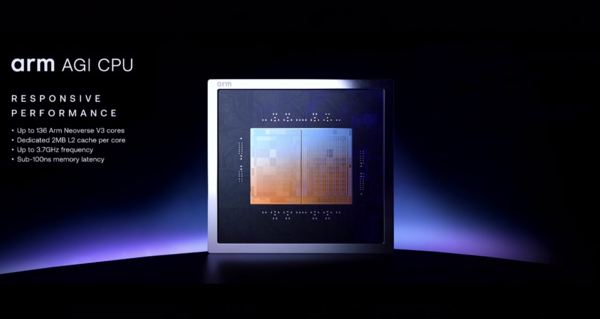
Arm on the 25th unveiled the 'Arm AGI CPU', a data centre CPU for agentic AI infrastructure. Based on the Arm Neoverse V3 architecture, it has up to 136 cores per CPU. It offers more than twice the performance per rack compared with x86 platforms, and supports memory bandwidth of 6GB/s per core and latency of less than 100ns.
In an air-cooled configuration, it supports up to 8,160 cores per rack, and more than 45,000 in a liquid-cooled setup. Its thermal design power is 300 watts. It assigns dedicated cores per program thread and supports predictable performance without throttling even under sustained load.
Arm CEO Rene Haas (르네 하스) explained that this gives partners more choices on a high-performance, high-efficiency computing foundation and enables them to build agentic AI infrastructure worldwide. With the move into the silicon business, Arm will provide the ecosystem with a three-stage platform choice spanning existing IP licences, computing subsystems (CSS) and directly designed silicon.
Arm's push into the silicon business is driven by a sharp rise in CPU demand tied to the shift to agentic AI. According to Arm, existing AI data centres have required about 30 million CPU cores per gigawatt. It estimates that the number of required cores will increase more than fourfold to 120 million when workloads shift to agent-based systems.
Agents repeat inference, planning and execution, increasing token generation by up to 15 times compared with humans. When an accelerator generates tokens, the CPU is solely responsible for processing, coordinating and routing them. Because agents generate requests around the clock, CPU bottlenecks have become a structural problem that directly limits accelerator utilisation. Haas said, "If someone pushes up a dump truck, you have to clear the dirt, and the CPU plays that role," explaining that agentic AI intensifies the structure.
◆Co-designing a multi-generation roadmap with Meta
The Arm AGI CPU was co-developed with Meta over about 2 years and 6 months. Santosh Janardhan (산토시 야나르단), head of infrastructure at Meta, said, "We searched across the market for a partner that could increase the number of cores per watt while maintaining performance, but when we got performance, power became a problem, and when we controlled power, performance was lacking." He said, "Arm was the only answer." Janardhan emphasised that the CPU "is not a chip just for Meta, but a foundation CPU for the entire ecosystem."
Meta currently has capacity of more than 1 gigawatt this year with the Prometheus cluster alone, and plans to expand the Hyperion cluster to 5 gigawatts in the coming years. Meta will operate the Arm AGI CPU together with its AI accelerator chip MTIA to improve orchestration efficiency for large-scale AI systems.
The two companies plan to continue cooperation not only for this first generation but across the next-generation roadmap. Janardhan said, "When you challenge the incumbent powerhouse, innovation appears across the ecosystem," and forecast that performance will scale across multiple axes in follow-on generations.
◆Samsung Electronics, SK Hynix to take centre stage in memory and packaging cooperation
In the global supply chain, the role of South Korean semiconductor companies is emerging. Samsung Electronics Vice Chairman Jun Young-hyun (전영현) said, "Performance improvement is increasingly determined by close joint optimisation across logic, memory and advanced packaging technologies," and added, "An AI computing platform designed for purpose like the Arm AGI CPU enables closer cooperation across silicon design, memory integration and manufacturing innovation using advanced process technologies." Samsung Electronics is positioned to strengthen its place in Arm's silicon ecosystem based on vertically integrated foundry, memory and packaging capabilities.
SK Hynix CEO Kwak Noh-jung (곽노정) said, "As AI data centres advance, a platform optimised for AI workloads requires advanced memory technology that provides the capacity and bandwidth needed for the latest applications," and added, "We hope the partnership with Arm for next-generation AI infrastructure development continues." As memory bandwidth requirements rise in proportion when CPU core counts quadruple, there is a view that this could lead to expanded demand for high-bandwidth memory, including HBM.
As Arm expands into the silicon business, demand is also expected to grow for optimisation that integrates CPU design with memory and packaging. Given the precedent of Arm CSS nearing about 20 percent of royalty revenue in 3 to 4 years after its introduction, the pace of growth in the silicon business is also in focus. As major ODMs beyond Meta participate in production, the broader the supply chain inclusion, the more concretely benefits for South Korean partners are expected to take shape.
 Seok Dae-geon
d2dg@d-today.co.kr
Seok Dae-geon
d2dg@d-today.co.kr