
The single-stock leverage market, which drew more than 19 trillion won in daily turnover early after launch, has contracted sharply in six months. As the broader stock market slid, the trading frenzy cooled. With semiconductor shares plunging, both leverage and inverse products recorded losses.
According to the Korea Exchange on Sunday, 16 single-stock leverage and inverse exchange-traded funds (ETFs) and 2 exchange-traded notes (ETNs) tied to Samsung Electronics and SK Hynix, first listed on the domestic market on May 27, all fell from their first-day closing prices.
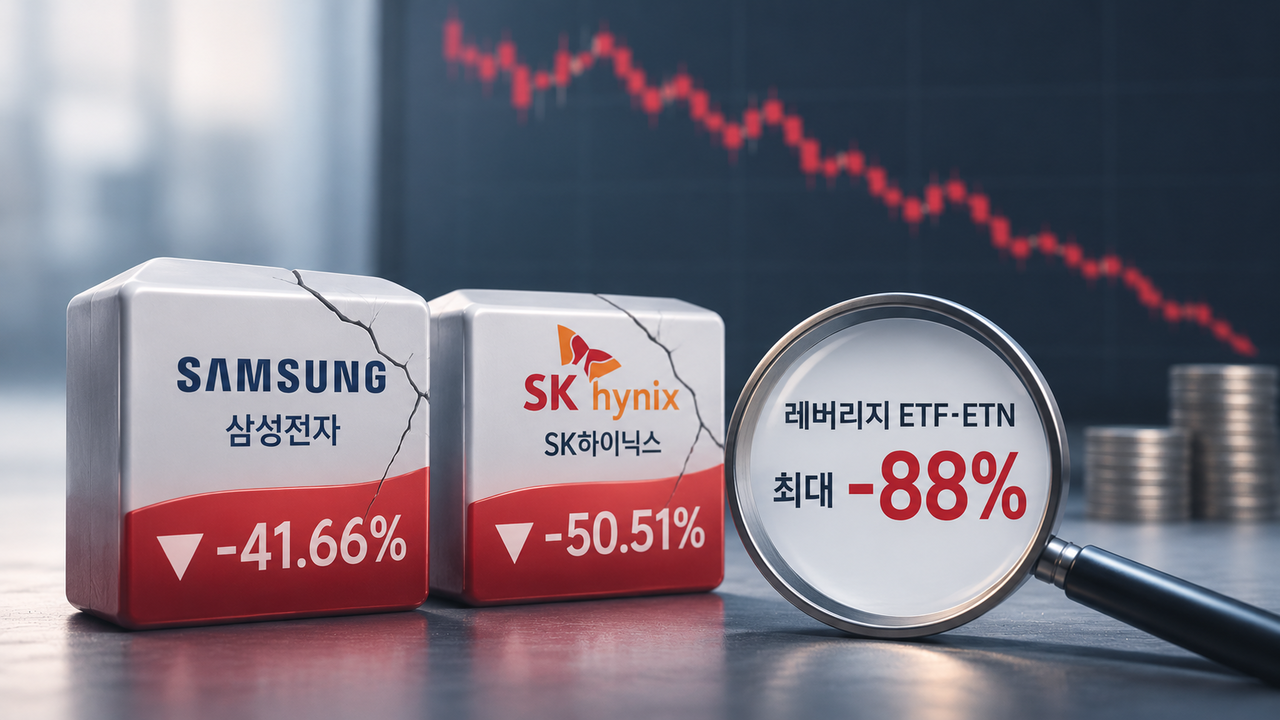
Over the same period, Samsung Electronics shares fell 41.66 percent to 179,100 won from 307,000 won, while SK Hynix dropped 50.51 percent to 1.11 million won from 2.243 million won.
The declines were steeper for leverage products that seek to track twice the daily returns of the two stocks.
The 7 Samsung Electronics leverage ETFs fell 76.90 percent to 78.33 percent. The flagship KODEX Samsung Electronics Single Stock Leverage fell 77.66 percent to 5,100 won from 22,830 won on the first day of listing.
The 7 SK Hynix leverage ETFs fell 86.24 percent to 87.81 percent over the same period. KODEX SK Hynix Single Stock Leverage fell 86.62 percent to 3,715 won from 27,775 won. The decline reaches 91.56 percent compared with the June 22 close of 44,000 won.
If an investor put 100 million won into the product at the early peak and held it to now, the investment would have shrunk to about 8.44 million won.
A notable point is that inverse products betting on declines in Samsung Electronics and SK Hynix also posted losses over six months. PLUS Samsung Electronics Futures Single Stock Inverse 2X fell 23.98 percent from its first-day level, and SOL SK Hynix Futures Single Stock Inverse 2X dropped 38.24 percent.
That is because leverage and inverse products are structured to track 2 times and minus 2 times daily returns, not cumulative returns over a certain period of the underlying asset.
As prices rise and fall repeatedly, compounding effects can reduce a product’s value, meaning losses can occur in inverse products even if the underlying stock falls.
Investor interest in single-stock leverage products was explosive early on. Combined turnover in the 16 ETFs reached 10.418 trillion won on the first day of listing, and surged to 19.4429 trillion won on June 24, about a month after launch.
From the listing date through July 30, just before the higher margin deposit measure took effect, average daily turnover stood at 11.6787 trillion won. Over that period, retail investors net bought a total of 15.2876 trillion won worth of the products.
The mood changed after financial authorities tightened margin deposit requirements.
Turnover on July 31, when the 30 million won cash margin deposit rule took effect, fell to 3.1518 trillion won. About a month later on Aug. 28, it dropped to 537 billion won.
Retail investor flows also turned to selling. From July 31 to Aug. 28, individuals net sold 1.773 trillion won worth of the 16 ETFs.
Average daily turnover in October fell to about 600 billion won, and combined turnover on the day marking six months since listing was tallied at about 354 billion won. That was down 96.6 percent from the first day of listing and 98.2 percent from June 24, when turnover was the highest.
Financial authorities said when introducing single-stock leverage products that the aim was to ensure regulatory parity between domestic and overseas financial products and meet diverse investor demand.
But as trading volumes grew faster than expected and volatility widened in Samsung Electronics and SK Hynix shares, authorities moved to draw up supplementary measures less than two months after the system was introduced.
On July 16, financial authorities temporarily halted new listings of single-stock leverage, inverse and covered call products. They also banned advertising and event-style marketing for existing single-stock leverage products.
To reduce the issue of trade volumes generated during management concentrating near the close, authorities also asked the asset management industry to spread out rebalancing times.
From July 31, authorities raised the margin deposit for retail investors to 30 million won from 10 million won. Previously, substitute securities such as stocks or ETFs were accepted, but they excluded them and required the margin deposit to be met in cash only. They applied the same standard to overseas-listed single-stock leverage products.
From Aug. 19, they required new investors to conduct mock trading for at least 5 trading days, for at least 1 hour a day. They also increased pre-education time to 3 hours from 2 hours.
To prevent excessive gaps between market prices and actual asset values for ETFs and ETNs, they tightened the gap management standard for liquidity providers’ domestic underlying asset products to 2 percent from 3 percent.
In addition, authorities are pushing a plan to expand the trading unit for single-stock leverage products to 20 units from 1 unit.
While the trading overheating has eased to a large extent, losses suffered by existing investors remain.
According to data from 10 comprehensive financial investment business operators that the Financial Supervisory Service submitted to the National Assembly during last month’s parliamentary audit, retail investors’ losses from the launch date of single-stock leverage products through Aug. 14 were tallied at 6.313 trillion won.
Of that, realised trading losses from sales were 2.3242 trillion won and valuation losses on holdings at the time were 3.9888 trillion won. The losses occurred in about two and a half months after launch.
Since prices of related products fell further as talk of an AI bubble spread and semiconductor shares slid, investor damage may have grown even larger.
Even recently, prices of related products have repeatedly risen and fallen by 10 to 20 percent in a day depending on moves in semiconductor shares. The barrier to entry for new investors has been raised, but the products’ high volatility and the risk of losses from long-term holding have not changed.
Single-stock leverage products, introduced on the pretext of diversifying financial products and revitalising the domestic capital market, have left a result of trading overheating, large-scale investment losses and repeated regulatory tightening in just six months.
An official at the financial investment industry said it is time to go beyond reduced trading volume and review overall investor protection for existing investors and the entire introduction and screening process for high-risk financial products.
 Oh Sang-yup
yub@d-today.co.kr
Keyword
#Korea Exchange #Samsung Electronics #SK Hynix #ETF #Financial Supervisory Service
