
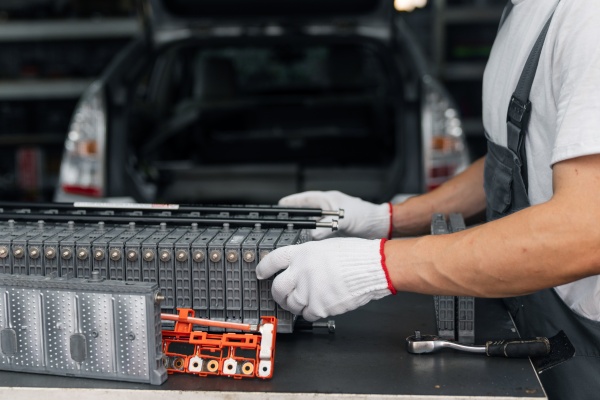
South Korea's waste battery recycling industry is rushing to build collection technology, processing facilities and circular raw-material systems to meet European Union recovery-rate standards. The EU plans to introduce recovery targets and a battery passport in 2027. From 2031 it will also apply, in phases, requirements for the share of recycled materials used in new batteries. For South Korean companies, it means a new market is opening outside China.
The EU will apply minimum standards requiring recovery of 50 percent of lithium and 90 percent of cobalt, copper, lead and nickel from waste batteries by 2027. In 2031, it raises those to 80 percent for lithium and 95 percent for cobalt, copper, lead and nickel. A digital battery passport system will also take effect in 2027.
According to the National Assembly Futures Institute, battery manufacturers must disclose material content, carbon footprint, supply chain due diligence information and resource circularity through the passport. The institute said that, as of 2018, 64 percent of life-cycle greenhouse gas emissions from batteries comes from the raw-materials production stage, from mineral extraction to active-material manufacturing. It projected that introducing the passport will increase demand for recycled materials and spur growth in the recycling industry.
Obligations to use recycled materials could be imposed on the new-battery production stage as early as 2031. Companies must fill 16 percent of cobalt, 6 percent each of lithium and nickel, and 85 percent of lead with recycled materials. Samsung SDI, LG Energy Solution and SK On all have production plants in Europe, and South Korea's three battery makers are expected to be affected.
South Korean companies are developing technologies that raise recovery rates in hydrometallurgical processes while reducing environmental burden. Hydrometallurgical processes can extract lithium and manganese, which are difficult to recover with pyrometallurgical processes. SK Ecoplant said it recovered 97 percent of nickel and cobalt and 90 percent of lithium using a solvent extraction method in 2023, while cutting water use by up to 50 percent. SungEel HiTech is developing an eco-friendly leaching process using organic acids as a government project. It is a method of producing through a process that reduces carbon emissions by 60 to 70 percent compared with mining.
According to the National Assembly Futures Institute, the volume of end-of-life electric vehicle batteries, based on battery capacity, is expected to rise to 76 times the 2025 level by 2040. Investments to expand processing capacity are also continuing. JHC, a unit of L&F, will add discharge and dismantling lines and respond with annual pre-processing capacity of 15,000 tons. Pre-processing is the process of making black mass, a black powder made by grinding waste batteries. Smelter LS MnM completed a battery materials Onsang plant at its Onsang Smelter in Ulsan on the 10th. The plant processes mixed hydroxide precipitate (MHP) together with black mass, and its nickel sulfate production capacity is 24,000 tons per year.
Cell makers and materials companies are tying facilities into circular raw-material systems. Samsung SDI said it will increase the share of recycled metals to respond to EU regulations, and operate a system that reinjects recovered minerals into battery manufacturing processes with regional partners. L&F is pushing a structure in which CIS Chemical post-processes black mass made by JHC to recover lithium, nickel and cobalt and use them to produce cathode materials. Ecopro said it has invested about 3.3 trillion won in Pohang since 2017 to link precursors, cathode materials and recycling. LS MnM also plans to supply products from the Onsang plant to precursor makers including LS-L&F Battery Solution.
Circular systems are also a means of competing with China in a growing market. According to SNE Research, the global secondary battery recycling market is expected to grow from about 22 trillion won this year to about 70 trillion won in 2030 and about 230 trillion won in 2040. China still leads in recycling feedstock processing capacity and scale. Trade conditions, however, are changing in ways that favor South Korean companies. The United States has tightened rules on foreign entities of concern (FEOC), raising the value of non-Chinese supply chains, and supports critical mineral recycling companies in North America with tax credits of 10 percent of production costs.
South Korea is also ahead in technological competitiveness. It cited high-purity metal recovery technology and linkage with the battery manufacturing ecosystem as South Korea's strengths. The National Assembly Futures Institute said changes in external conditions, including the battery passport, could be an opportunity for South Korea, which has a low share in materials. The Ministry of Planning and Budget also said in May it would reflect battery circular economy-related budget items in the 2027 budget plan. An industry official said, "If domestic companies put forward a circular system tied to cell makers, there is room to reverse the disadvantage in processing scale in the long term."
 Daegeon Seok
d2dg@d-today.co.kr
Keyword
#European Union #Samsung SDI #LG Energy Solution #SK On #National Assembly Futures Institute
