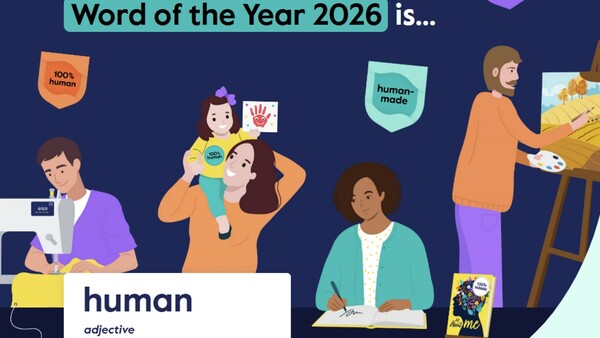
As AI spreads across human creativity and daily life, Britain’s Cambridge Dictionary has selected the adjective "human," meaning "humane," as its 2026 word of the year. Analysts say uniquely human values are being revisited as a growing movement seeks to distinguish AI-generated output from human creations.
Gigazine, a Japanese media outlet, reported on Nov. 19 that Cambridge Dictionary on the previous day selected "human" as the word of the year and revealed the reasons.
Cambridge Dictionary defines "human" as an adjective that describes the characteristics, emotions and flaws that people have. It said it was once mainly used to distinguish humans from animals or gods, but recently it has taken on a stronger meaning of contrasting AI and humans.
In practice, compound expressions such as "human-written," "human-generated" and "human-made" are increasing. That is because as AI generates writing, images and even music, the need has grown to specify whether the creator is a human.
Colin McIntosh (콜린 매킨토시), editor at Cambridge Dictionary, said, "AI has been spreading through society for several years, but this year it felt like it was everywhere." He added, "It has led us to reassess what it means to be human in contrast to AI, and new value is being assigned to human elements."
One expression reflecting this trend is "human premium." It means people seek differentiated value in works or products made directly by humans in an era when AI mass-produces content.
A newly coined term that emerged this year, "humanmaxxing," also drew attention. It refers to activities aimed at maximizing human physical ability, health and lifespan. Still, concerns have been raised about side effects because some cases involve using unverified drugs or medical procedures.
"Friction-maxxing," which involves intentionally keeping a distance from digital technology, is also spreading. It refers to behavior aimed at reducing dependence on digital devices by giving up some convenience and adding discomfort to daily life.
Typical examples include asking a friend for restaurant recommendations instead of requesting them from AI, visiting neighborhood shops instead of shopping online, and taking notes on paper instead of using smartphone apps.
Cambridge Dictionary said the world has entered an era in which AI generates content that is hard to distinguish from what humans make. It stressed that people should again ask what it means to exist as a human in the AI era.
 Choi Jae-won
ittt_0801@d-today.co.kr
Keyword
#Cambridge Dictionary #Gigazine #Colin McIntosh #humanmaxxing #friction-maxxing