
[Busan=Digital Today reporter Lee Ho-jung] Webzen will present command-focused gameplay in its new title "Defence Game Tyrant: Last Stage" ("Digempok"), highlighting a package-game-like experience and users' strategic decision-making.
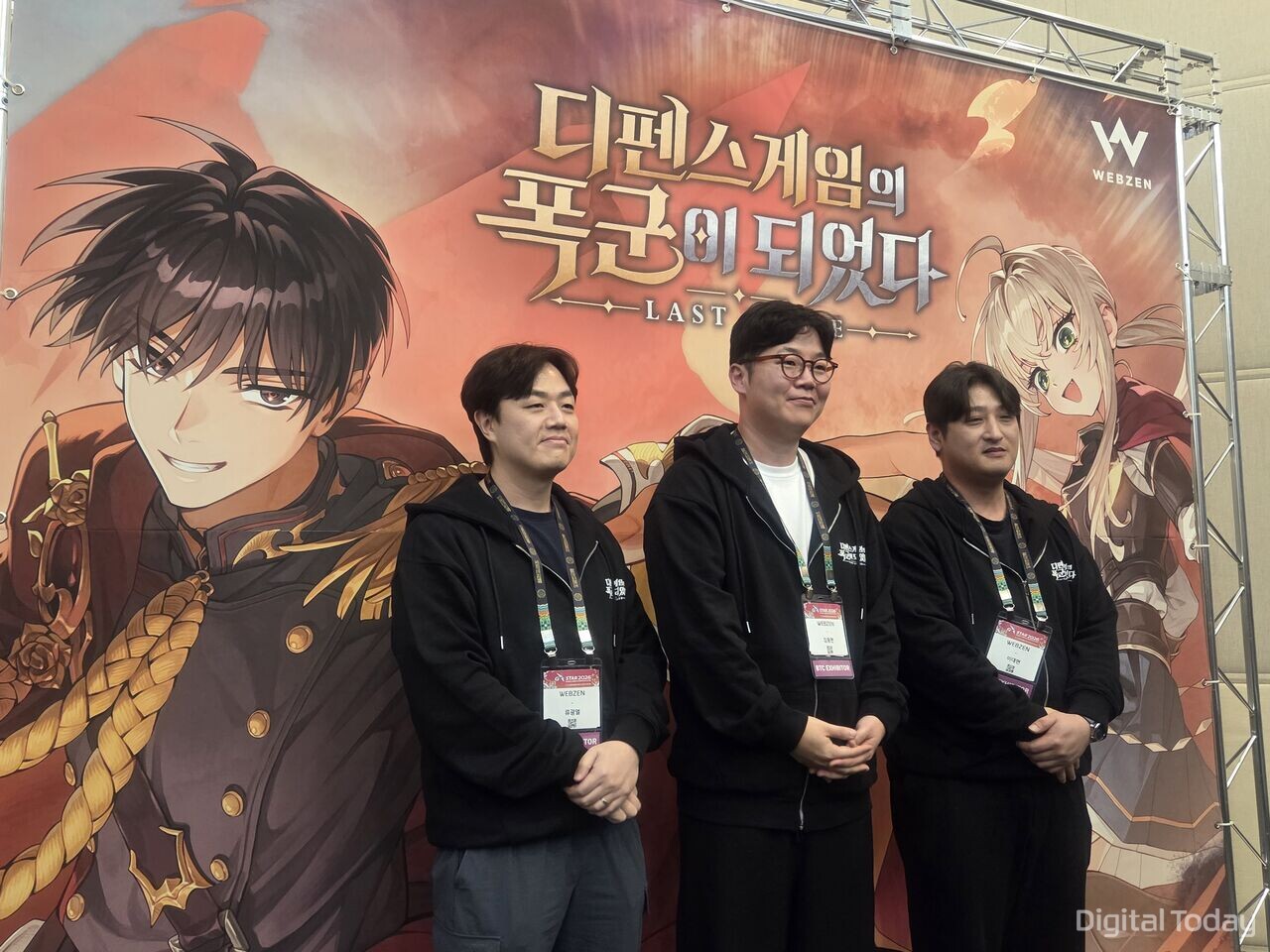
Webzen held a joint media interview for "Digempok" at BEXCO in Busan on Nov. 19 and unveiled key content and its development direction. Attendees included Webzen Crevice CEO Kim Dong-hyun (김동현), planning team head Ryu Gwang-yeol (류광열) and art team head Lee Dae-hyun (이대현).
"Digempok" is a command strategy RPG in development based on the popular Naver Webtoon "Defence Game Tyrant." It rebuilds the original work's exploration, territory management and defense-battle structure into game systems and combines it with raid content.
Asked whether it intended an experience similar to a package game, Ryu said, "The most important planning point was that we wanted it to look like a package game."
Ryu also explained why the team defined the genre as a "command strategy RPG." "The reason we put the word command at the front is because it is the philosophy that runs through the entire game," he said. "The most fun element is for users to make appropriate choices that fit their situation at important points in each piece of content."
Kim also said the team wanted to translate the experience of following characters' choices in the original work into an experience in which the player makes judgments directly. He said the team focused on realising the experience of becoming the protagonist Ash and protecting companions and a city.
Exploration through raids... an original work rebuilt around "command"
The game's core content is a recurring cycle that runs through exploration, territory, defense battles and raids. It highlights the role of a commander by varying the decisions users must make at each stage.
In exploration, players identify enemies' traits and surrounding environmental characteristics and develop companions. Combat can use attributes and status effects, such as causing electrocution by applying current to enemies soaked in puddles, or triggering explosions by giving certain objects a burning effect.
In territory, players manage facilities and resources and assign roles to companions. In defense battles that follow, they check battlefield information such as the order of enemy attacks and the weather, deploy forces, and respond during combat using command tools.
In raids that follow defense battles, players must change party positions after identifying a boss's attack patterns and danger zones. Players form a group of selected companions and reserve companions, and can change the composition to reserves when clearing a stage or when the party is wiped out.
During development, the team put particular effort into exploration and defense battles. Kim said it placed importance on the fun of exploration and spent more than six months deciding the defense-battle structure to portray large-scale enemy invasions.
The story of the original work will also be rebuilt for the game. The company plans to add stages from the original work through periodic updates after launch, and fill in new stories for sections that were omitted or skipped quickly in the original.
Kim said the team is adding new stories in consultation with the original author, and said it will present an original story unique to the game within a range that does not damage the original setting.
Plan to let players acquire characters through play... mobile and PC cross-platform under review
The service model also seeks to differentiate from existing collectible RPGs. The developers plan to introduce an element of collecting characters from the original work, while devising a way for users to obtain characters simply by playing the game.
Ryu said, "We are devising a way so that if you purely just play hard, you can obtain all the characters you can meet in the original work."
However, this was an explanation of the development direction, and a specific monetisation model or character acquisition method has not yet been disclosed.
The company is considering expanding platforms beyond mobile to PC. Ryu said it is planning mobile and PC cross-platform play, but the currently disclosed closed beta test will be conducted for Android and iOS mobile devices.
Competitive content between users focuses on how efficiently they clear the same tasks and achieve high scores, rather than real-time matches. It is not currently considering cooperative content where users meet in person to play together.
For graphics, it applied a diorama pixel-art approach that combines Unreal Engine 5-based 3D backgrounds with hand-crafted 2D dot characters. It also uses camera direction and 3D effects to convey the scale of large battles.
Kim said it uses AI as an auxiliary tool for planning and programming work, but does not use it for art production. He said specialists directly produce the dot characters frame by frame.
Targeting release in the first half of 2027... testing gameplay in CBT
In a question-and-answer session, Kim presented the first half of 2027 as the target release window for "Digempok." It is a more specific schedule than the previously disclosed plan for a 2027 release.
Webzen began recruiting CBT participants from users in South Korea, Japan and Taiwan starting on Nov. 19. The test will be conducted on Android and iOS mobile devices, and participants will be selected by lottery. The actual test schedule will be disclosed later.
Kim said the G-Star demonstration focused on showing how the original work was implemented as a game, and said the CBT will additionally reveal core content and verify the game's fun factor.
The CBT will also present more varied illustrations and story direction than the current demonstration. Webzen said it plans to raise the completeness of key content by gathering user feedback and prepare for an official launch.
 Lee Ho-jung
lhj@d-today.co.kr
Keyword
#Webzen #BEXCO #Naver Webtoon #Unreal Engine 5 #Defence Game Tyrant: Last Stage
