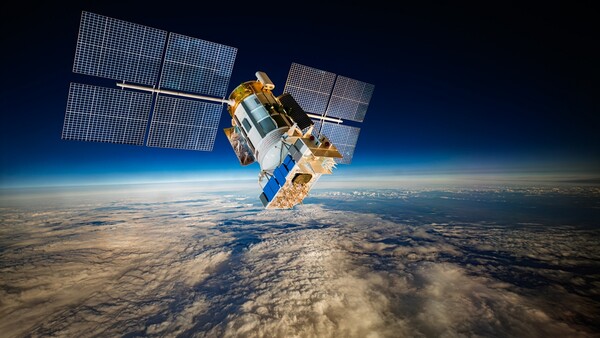
Research has found that even a single nuclear detonation in space could cause most artificial satellites in low-Earth orbit to lose functionality. The analysis said the cumulative effect of radiation trapped in Earth's magnetic field could pose a bigger threat to satellite communications networks and space infrastructure than radiation immediately after the blast.
On Nov. 19 (local time), Japanese media outlet Gigazine reported that a joint research team from the University of Wisconsin-Madison and Princeton University posted a paper on the preprint platform arXiv with those findings.
The researchers simulated post-detonation radiation exposure, satellite shutdowns and collision risks using data on 13,306 satellites in low-Earth orbit as of January. The study assumed a 1-megaton nuclear detonation at an altitude of 500 km above the South Atlantic, about 50 times the power of the Nagasaki atomic bomb.
The analysis found that only about 2.9 percent of satellites lost function due to radiation immediately after the blast. After 1 day, 25 percent were disabled. After 3 days, 78 percent were disabled. After 1 week, about 98 percent were disabled.
The reason the damage grows is an artificial radiation belt. Electrons emitted from radioactive material created by the explosion become trapped in Earth's magnetic field, forming a radiation belt and exposing satellites to radiation each time they repeatedly pass through the region.
Even under conditions in which satellites' radiation tolerance was tripled, the study predicted about 97 percent would lose functionality within 15 days.
Similar damage has occurred in the past. The United States conducted the Starfish Prime nuclear test in July 1962 at an altitude of about 400 km. The artificial radiation belt formed at the time damaged existing satellites as well as satellites launched later.
Satellite failures could also lead to additional space disasters. Disabled satellites cannot perform orbital adjustments to avoid collisions.
The researchers estimated that about 20 collisions could occur over the 2 years after a nuclear detonation, including collisions involving satellites and space debris. Debris created by collisions also threatens other satellites.
Some satellites re-enter Earth due to atmospheric drag, but the effects of radiation and space junk could persist for years. That means it could be difficult to quickly restore communications and observation services even if new satellites are launched.
The results, however, are based on a simulation that assumes a specific detonation location and satellite radiation tolerance. The researchers said the actual scale of damage could vary depending on the conditions of the explosion, and stressed the importance of international efforts to prevent the deployment and use of nuclear weapons in space.
 Jae-won Choi
ittt_0801@d-today.co.kr
Keyword
#arXiv #University of Wisconsin-Madison #Princeton University #Starfish Prime #South Atlantic