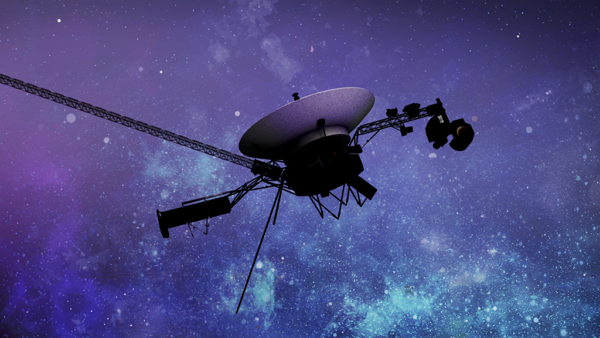
NASA's uncrewed space probe Voyager 1 is estimated to have reached a distance of about one light-day from Earth. As Voyager 1, the farthest-flying spacecraft sent by humanity, set a new distance milestone, a new era has begun in which communication between Earth and the probe takes more than a day.
According to tech media outlet Engadget on Nov. 18 local time, NASA believes Voyager 1 likely passed the one-light-day point from Earth that day. The exact time of passage has not been confirmed. That is because the probe's signal must arrive at Earth to determine whether it reached the point and when.
One light-day is the distance light travels in a day, equal to about 25.9 billion km. Because radio waves also travel at the speed of light, it takes about 24 hours to send commands from Earth to Voyager 1 and another 24 hours to receive a response from the probe. That means it takes about two days just to send a command and confirm the reply.
Voyager mission manager Karim Badaruddin called the milestone an unprecedented moment. He said, "This has never happened before, and it could be an event so special that it may never happen again."
Voyager 1 was launched in 1977. At the time, NASA pursued the Voyager program to study not only planets in the solar system but also interstellar space beyond it. Although it departed 16 days later than its twin probe Voyager 2, Voyager 1 is now flying farther. It is also the farthest-advancing probe among all space probes launched by humanity.
Voyager 1 entered interstellar space in 2012. Interstellar space refers to the region between star systems such as the solar system. After crossing the boundary where the influence of the solar wind weakens, the probe has continued moving through space and sending observation data back to Earth.
The mission has not been smooth throughout. Voyager 1 experienced several technical anomalies during operations, and NASA has progressively switched off some instruments and functions to cope with the gradual decline in energy from its plutonium power source. The measures were intended to keep the mission going as long as possible with limited power. Even so, the probe continues operating to this day.
NASA said Voyager 1 has flown for about 49 years, 2 months and 11 days since launch and is about 16 billion miles from Earth. In the direction the probe is heading lies the star Gliese 445 near Ursa Minor. The star is about 17 light-years from Earth.
Voyager 1 will need tens of thousands of more years to approach Gliese 445. Current estimates project it will pass a point about 1.7 light-years from the star in about 40,000 years. It will not reach the star directly, but it is a long-term journey in which a human-made probe moves closer to another star system.
Reaching one light-day is a symbolic milestone in Voyager 1's long spaceflight. As the distance between Earth and the probe has grown to what light travels in a day, it shows both the reach of human space exploration technology and the physical limits of communications.
 Jinju Hong
hongjj@d-today.co.kr
Keyword
#NASA #Voyager 1 #Voyager 2 #Gliese 445 #Engadget