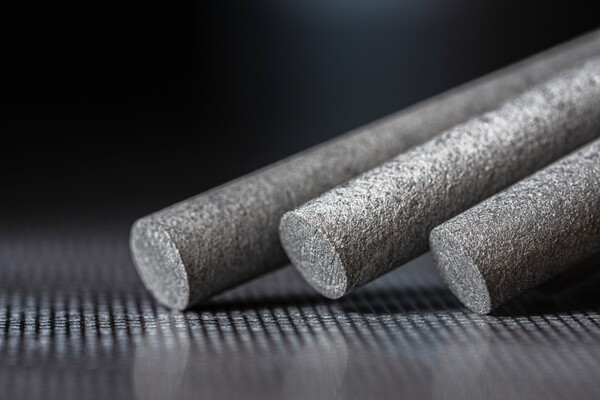
U.S. startup Molten Industries has begun operating a pilot plant to produce battery graphite. The move aims to prove the price competitiveness of U.S.-made graphite in an anode supply chain dominated by China and to build a local supply chain for battery materials.
TechCrunch reported on Nov. 18 local time that Molten Industries has set up a pilot plant in Oakland, California, capable of producing about 300 tonnes of graphite a year. The output is equivalent to about 300 megawatt hours of battery capacity, enough for about 4,300 electric vehicles.
Most of the graphite produced at the plant will be supplied to undisclosed customers that are testing its use in battery cells. The plant is intended to validate the technology and lay the groundwork for expansion to a large-scale production facility.
Graphite is a key material for lithium-ion battery anodes, storing lithium ions during charging. But the global supply chain is heavily concentrated in China. Benchmark Mineral Intelligence said Chinese companies control about 75 percent of the graphite anode supply chain, and account for 97 percent of synthetic graphite anode production.
Molten Industries has focused on price competitiveness to change the China-centric supply structure. Co-founder and chief technology officer Caleb Boyd (케일럽 보이드) said the cost of graphite produced at the Oakland plant is similar to the level of Chinese products plus tariffs. He said a follow-on plant can secure costs that can compete with Chinese products even without tariffs.
The company’s key competitive edge lies in a production process that separates methane into carbon and hydrogen. It uses resistive heating, which runs electricity through material to heat it. Boyd described the equipment as “a device similar to a giant toaster.”
The process heats methane in the absence of oxygen to separate carbon and hydrogen. The hydrogen generated is sold to nearby customers, while the carbon is processed to meet the quality required by battery makers and turned into graphite.
The company says the method can cut electricity use to about one-third of that of existing processes. It also highlighted the advantage of using natural gas, which is produced abundantly in the United States, as a feedstock.
The business direction has also shifted from its initial plan. Molten Industries initially planned to use natural gas to produce clean hydrogen and sell leftover carbon as a byproduct. But in the process of solving a problem in which carbon built up inside the reactor, it confirmed it could produce high-quality graphite. It then shifted to a business model that makes battery-grade graphite its main product while selling hydrogen as well.
Co-founder and chief executive Kevin Bush (케빈 부시) said the company judged it would be difficult to secure cost competitiveness by simply following China’s production process. The idea is to use abundant natural gas in the United States and innovate the production process to lower global graphite production costs.
The company expects its graphite and hydrogen businesses could each create revenue opportunities worth tens of billions of dollars. It said supplying graphite to the entire U.S. battery market could also meet about one-third of U.S. hydrogen demand. It also suggested the possibility of expanding into other industries, including thermal batteries that store heat energy, beyond battery graphite.
It plans to expand production by replicating multiple times the equipment configuration validated at the Oakland plant. It has not yet disclosed the specific location or construction schedule for a follow-on plant.
The launch of the pilot plant is expected to be a test of whether the United States can diversify a battery materials supply chain concentrated in China. The key question is whether it can secure prices that can compete with Chinese products in mass production as well as in technology validation. Boyd called the plant launch an important milestone not only for the company but also for the global graphite industry.
 Jinju Hong
hongjj@d-today.co.kr
Keyword
#Molten Industries #Oakland #TechCrunch #Benchmark Mineral Intelligence #graphite