
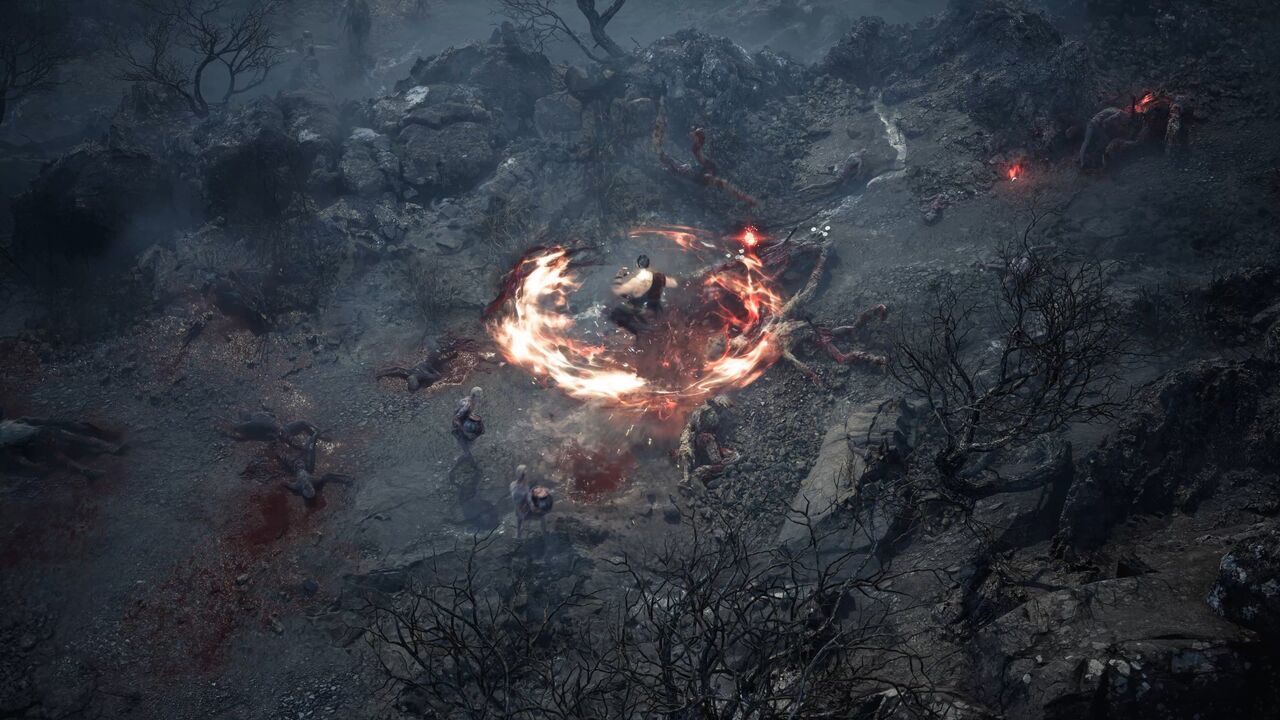
[Busan=Digital Today reporter Hojeong Lee] Krafton is moving to differentiate the combat and progression systems of its Eastern fantasy action RPG “Tara: Unbound,” targeting a 2027 release.
Krafton held a media hands-on session in Seoul on Nov. 11 for “Tara: Unbound,” an entry for G-Star 2026. A joint interview was attended by Boundary CEO Inyoung Koo (구인영), art director Byeongho Park (박병호) and creative director Myeongsang Yoo (유명상), who explained the development direction and release plans.
“Tara: Unbound” is an Eastern dark fantasy action RPG based on Buddhism’s cycle of reincarnation and reinterpreting the history and culture of Korea, China, Japan and Mongolia from the 15th to 17th centuries. Classes reflecting East Asian cultural characteristics appear, including “Mansin,” inspired by a Korean shaman, “Chakho-gap-sa,” drawn from Joseon-era tiger hunters, and “Kunoichi,” a reimagining of a Japanese ninja.
The developers drew distinctions not only in the Eastern setting but also in combat. Fights against ordinary monsters are designed to deliver the fun of quickly dispatching many enemies, while boss battles are built to make precise control and dodging in response to attack patterns important. Each class has different combat styles and skill setups to provide different play experiences.
Koo said, “When we started developing Tara: Unbound, we set two points. One was to carry over the exhilarating fun of mob hunting and farming found in existing hack-and-slash games, and the other was to add even stronger action and weight to that.” She said the team is still steadily working to balance the thrill of mob hunting in PvE with the tension of boss battles.
◆Weighing how to combine East Asian cultures... an original world instead of real country names
One of the difficult parts of development was combining the history and culture of multiple East Asian countries into a single world. Early on, the concept was based on a limited region, but after expanding the cultural scope, the team needed to explain in narrative terms why characters from different areas would set out on a journey toward a single goal.
The team also considered that expressions of specific countries or cultures could be received sensitively, given historical conflicts among East Asian countries. Rather than using real country names, it reconstructed elements taken from each region’s history and culture to create an original world.
Park said, “As we mixed several East Asian countries into one world, our biggest concern was the misunderstandings that could arise if we put forward a specific country.” He said the team was as cautious as possible not to touch sensitive elements, given the region’s history of conflict.
In character design, the focus was on moving away from the typical look of fantasy RPGs. Rather than making every character young and beautiful, the team reflected each character’s past, personality, age and occupational traits in their appearance. The sound is also being produced to interpret an Eastern atmosphere in a modern way, using Western instruments rather than relying only on traditional instruments.
The team also checked how overseas users respond to the Eastern world. Koo said she had worried at Gamescom that unfamiliar concepts such as the cycle of reincarnation and yin-yang and the five elements could be a barrier for Western users, but instead received many reactions saying they felt fresh.
Koo said the direction has not changed significantly, but the team discussed ways to make such terms and concepts easier to convey and debated improvements.
◆Easy campaign, deep endgame... preparing packaged sales and seasonal system
“Tara: Unbound” is being designed to separate a story-centered campaign from an endgame focused on character growth.
The game is structured so that 6 seekers travel together. Even if players use only 1 class, they can understand the full story, so there is no need to repeat the campaign with multiple classes just to follow the story. This was decided so users can move into the endgame after completing the campaign without separate replay runs.
The progression approach also differs by stage. The plan is to reduce the burden for users unfamiliar with the genre by following developer-presented growth paths in the campaign, while enabling freer character building in the endgame by expanding combinations of skills and traits.
Yoo said, “In the campaign section, we are setting an approach where players proceed according to a developer-defined tree rather than excessively diverse builds.” He said the team is focusing on build diversity, including trait customisation and yin-yang traits, so players can fully feel the expansion of build crafting, a strength of the genre, in end content.
The endgame is being prepared as a system that offers new fun with themes of reincarnation and karma, without relying only on item acquisition. However, specific content has not been disclosed yet. PvP content is also not being considered at this time.
A seasonal system is also planned for long-term operation. The team is considering adding content, skills and auxiliary arts by season, adjusting existing balance, and introducing new characters as downloadable content (DLC).
For sales, the basic plan is packaged purchase, with the goal of simultaneous release on PC and consoles. Detailed business models, including in-game cosmetic elements, are being discussed with publisher Krafton.
Koo said, “We are continuing to think about a more user-friendly business model.” She said specific business models will be disclosed at an appropriate time once discussions with the publisher have progressed to some extent.
The developers are working in parallel on producing content and raising quality to meet the current release schedule. To address convenience issues raised at Gamescom, they also added a floating gauge that allows players to check health and resource status. The function can be enabled in game options.
At this year’s G-Star 2026, players can try new skill setups for classes already revealed and a new class, “Tugwi.” The developers plan to gather user feedback at the event and reflect it in improvements to control convenience and the combat system.
 Hojeong Lee
lhj@d-today.co.kr
Keyword
#Krafton #Tara: Unbound #G-Star 2026 #Boundary #Gamescom
