SK Broadband will build an international quantum-security test network on the subsea cable section linking Busan, South Korea, and Singapore. It will verify security for international communications networks by combining quantum key distribution (QKD) and post-quantum cryptography (PQC).
SKB said on Nov. 19 it will build a quantum-security test network on the Busan-Singapore section of SJC2 (Southeast Asia-Japan Cable 2), a subsea cable connecting the Asian region.
SKB was selected last month as an operator for the "open quantum testbed advancement and expansion" project led by the Ministry of Science and ICT and the National Information Society Agency (NIA). The open quantum testbed is a demonstration environment where companies and research institutions jointly use quantum cryptography communications test networks and expensive measurement equipment to verify the performance of technologies and products.
Under the project, SKB will pursue international quantum-security demonstrations linked with quantum testbeds in Singapore and in Poland and Bulgaria. It will apply QKD to domestic and overseas local communications sections, and PQC to the long-distance Busan-Singapore subsea cable section. By building a hybrid quantum-security system combining the two technologies, it will verify whether data can be transmitted safely on international sections.
If quantum computer technology advances further, the effort will focus on responding to a "harvest now, decrypt later" security threat in which currently encrypted data is collected in advance and decrypted later. It also plans to check whether South Korean quantum-security technologies and equipment operate stably on overseas communications networks.
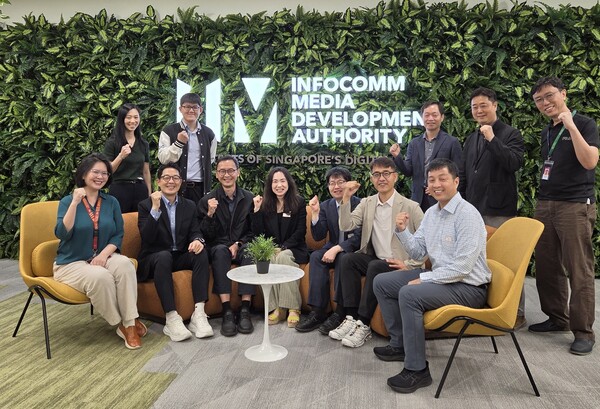
Separately, SKB recently visited Singapore with NIA and quantum computing company IonQ to 추진 the project. The delegation visited the Global Switch data centre in Singapore to review conditions for installing quantum-security equipment at the subsea cable landing section and ways to link with local telecoms operator Singtel. It also visited satellite-based quantum communications company SpeQtral and the Centre for Quantum Technologies at the National University of Singapore to discuss technology cooperation.
At Singapore’s Infocomm Media Development Authority (IMDA), it discussed with Singtel an international test network structure linking South Korea’s QKD section, the PQC section on the SJC2 subsea cable, and Singapore’s quantum-safe network. It also discussed cryptographic key interworking in line with European Telecommunications Standards Institute (ETSI) standards and an 추진 schedule to open the testbed in 2027.
Jin-soo Seong (성진수), head of SKB’s Network Center, said, "Through this overseas quantum-security demonstration project in cooperation with Singapore, we will not only build quantum-security network systems between countries but also open up opportunities for excellent domestic quantum-security companies to expand overseas."
Young-hee Kim (김영희), head of NIA’s Quantum Technology Utilization Center, said, "With this cooperation, we will contribute beyond interworking and demonstrations of quantum-security networks between countries to commercial services and promoting quantum industrialization."
 Jin-ho Lee
jhlee26@d-today.co.kr
Keyword
#SK Broadband #SJC2 #Busan #Singapore #IMDA