
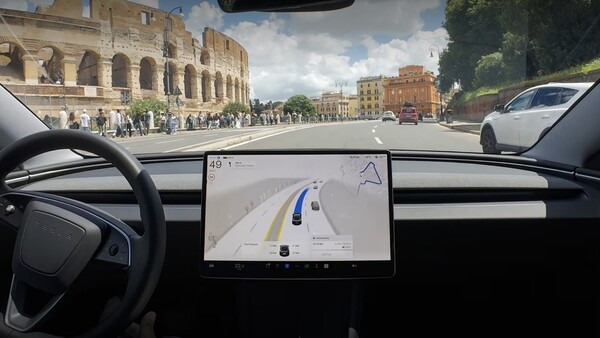
[DigitalToday reporter Jae-won Choi (최재원)] Tesla is tightening driver monitoring standards for its assisted driving system in Europe. It will send warnings faster when drivers take their eyes off the road and change the system to impose immediate penalties in certain situations. In the United States, by contrast, it is moving to ease driver monitoring, drawing attention to differences in regulation by region.
Electrek reported on Nov. 18, local time, that the Dutch vehicle authority RDW approved Tesla's 'Tesla Assisted Driving (TAD)' software update on Nov. 16. The update applies to vehicles equipped with fourth-generation self-driving hardware (HW4) or later and will be distributed via over-the-air updates (OTA).
The main change is stricter requirements for driver attention. The system will display warnings earlier than before. If the driver does not watch the road ahead while the car performs driving operations such as changing lanes, it will immediately impose a 'full strike'. This is a record of penalties for driver inattention.
High-speed conditions also became stricter. At speeds above 130 km per hour, drivers must keep their hands on the steering wheel. To set a value higher than the system's suggested top speed, drivers must operate the steering wheel scroll wheel to reconfirm. If the vehicle drives faster than the system standard, the speed limit sign will flash red.
RDW said that verification of the update on test tracks and public roads found no negative impact on vehicle driving. It said 11 European countries, including the Netherlands, currently recognize the approval, and review for European Union-wide approval is continuing.
Earlier, on Nov. 3, Tesla changed the name of 'FSD (Supervised)' in Europe to 'Tesla Assisted Driving' and reduced the allowable setting range for exceeding the speed limit from a maximum of 50 percent to 10 percent. These were items Germany had presented as conditions for supporting EU approval.
In the United States, by contrast, software changes continued in a direction that reduces driver warnings. Tesla Chief Executive Elon Musk (일론 머스크) caused controversy last year with remarks suggesting he would allow text messaging while using FSD.
However, FSD is still a Level 2 driver assistance system that requires constant driver supervision. In the United States as well, using text messages while driving is illegal in most states.
Safety controversies are also continuing. Last month in California, a vehicle whose driver said he fell asleep while using FSD entered a controlled section of a highway and crashed into a patrol car, seriously injuring 2 police officers.
The U.S. National Highway Traffic Safety Administration (NHTSA) is investigating FSD-related collisions that occurred in low-visibility conditions. Analysis suggests that Europe's pre-approval process and the United States' post-regulation approach are creating differences in Tesla's region-by-region driver monitoring policies.
 Jae-won Choi
ittt_0801@d-today.co.kr
Keyword
#Tesla #FSD #RDW #NHTSA #European Union
