
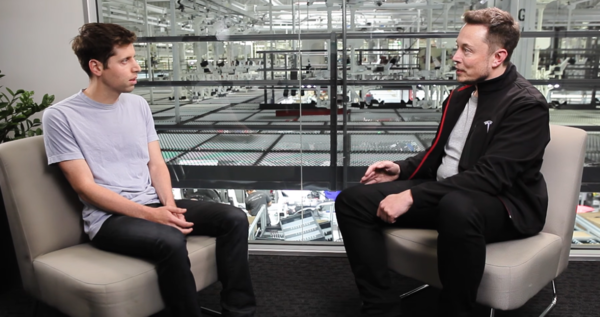
Sam Altman (샘 알트먼), CEO of OpenAI, publicly criticised Elon Musk, saying he does not want a future in which humans live like AI pets.
On Nov. 18, Business Insider reported that Altman, speaking at the New York Times DealBook Summit, took aim at Musk's past remarks that AI could become more powerful than humans and turn humanity into pets kept at home.
Altman said, "I don't want to be a labrador. I don't want my kids to be labradors." He added, "People should have agency over the future, as they have until now."
For more than 10 years, Musk has warned that if AI reaches a stage of recursive self-improvement, it could escape human control. Recursive self-improvement is a process in which AI improves itself without human intervention and develops higher intelligence. In a 2015 conversation with astrophysicist Neil deGrasse Tyson (닐 디그래스 타이슨), Musk voiced concern that AI could redesign itself and rapidly repeat improvements 24 hours a day across millions of computers.
In a July interview with The Economist, Musk referred to his past remarks that humans could become like labradors and said with a laugh, "Labradors are pretty happy animals." In 2016, he also said he did not like the idea of becoming a house cat. At the time, Musk argued that to avoid such a situation, humans would need to connect their brains to computers.
Altman has recently repeatedly stressed that the industry should not accept a situation in which humans hand control over to AI. At the DealBook Summit, he and OpenAI President Greg Brockman (그렉 브록먼) said, "We deeply believe that people should continue to control the future." They added, "There is growing discussion that we should gradually hand authority over to AI, but that is a terrifying idea."
Concerns over control of AI are emerging as a major industry agenda item. In September, after Dario Amodei (다리오 아모데이), CEO of Anthropic, proposed slowing the pace of self-improvement research on cutting-edge AI and preparing measures to maintain human control, Altman and Musk also agreed. The aim is to find ways to control AI safely while adjusting the pace of research.
The conflict between the two has continued for a long time over a shift in OpenAI's business direction. Musk was a co-founder and early investor of OpenAI, but filed a lawsuit against Altman and OpenAI in opposition to the change in direction. In May, a jury found that Musk waited too long to file the lawsuit, and the court accepted that and dismissed the claim.
 Seung-a Yoo
ysah@d-today.co.kr
Keyword
#Sam Altman #Elon Musk #OpenAI #DealBook Summit #Recursive self-improvement
