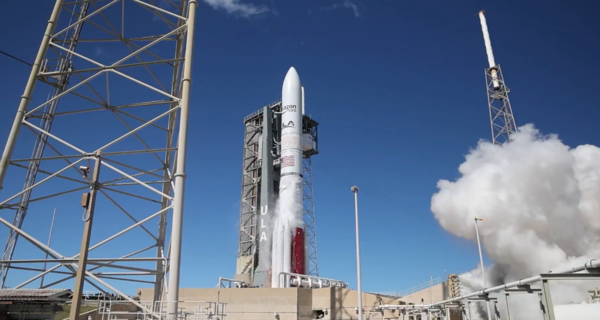
[Digital Today Yu Seung-a, intern reporter] The cause of a failed launch of United Launch Alliance's (ULA) Vulcan rocket has been narrowed to a fuel supply shortfall rather than an engine defect. The result eases the burden, for now, on Blue Origin, which supplies the key engines. But ULA's business position is expected to become more uncertain as Vulcan remains grounded.
On Nov. 18 (local time), IT outlet Ars Technica reported that ULA has completed an initial review of flight data on an anomaly during the "LEO 1" launch that occurred on Nov. 15. A preliminary investigation found that low booster thrust was not due to performance problems with the BE-4 engine supplied by Blue Origin, but because of insufficient fuel supply from the rocket airframe to the engine. The investigation to determine the exact cause is continuing.
The result is also significant for Blue Origin, which uses the BE-4 engine. The BE-4 is installed not only on ULA's Vulcan but also on Blue Origin's heavy-lift rocket New Glenn. New Glenn suffered an explosion during a ground test in May, and the cause at the time was identified as a problem with the BE-4 engine's main oxygen valve. Blue Origin later improved the valve and applied it to New Glenn and Vulcan. With the preliminary finding that the Vulcan incident is unrelated to the improved valve, Blue Origin can move to resume New Glenn flights as early as January next year.
It is also positive news for the U.S. space agency NASA. That is because Vulcan's upper stage, Centaur V, has been confirmed not to have affected the launch failure. NASA recently signed a contract with ULA to use Centaur V as a new upper stage for the Space Launch System (SLS). It also plans to use New Glenn for future lunar exploration missions and a crewed lunar landing plan within this decade. In the U.S. space industry, where launch demand is concentrated, New Glenn is also seen as a short-term alternative for satellite operators, including Amazon's Kuiper constellation.
ULA's situation, by contrast, has become more difficult. Vulcan is the key launch vehicle that supports ULA's position in the U.S. launch market, where rivals such as SpaceX and Blue Origin are rising. While Vulcan operations are halted, newer companies such as Relativity Space, Rocket Lab and Stoke Space could expand their market share.
The mission was Vulcan's fifth flight and its first mission failure. Nozzle problems occurred in the two prior launches involving solid rocket boosters, but the missions were successful. ULA has worked over the past 3 years to transition Vulcan to a regular operations cadence, and it expected that a successful launch would allow it to establish a schedule of at least one launch per month next year.
ULA now faces a new technical challenge on top of funding difficulties. It needs to inspect the propellant management system and complex piping that supply liquid oxygen and methane to the BE-4 engines. Vulcan's grounding is also expected to continue for several months.
 Yu Seung-a
ysah@d-today.co.kr
Keyword
#United Launch Alliance #Vulcan #Blue Origin #BE-4 #NASA