Ukraine attacked Russia's key supply route, the Kerch Strait bridge, using a drone relay communications network without relying on Elon Musk's Starlink satellite network. The operation used missiles and drones, collapsing a key structure on the road bridge. Disruptions are expected to Russia's logistics system in the Crimean peninsula.
On Nov. 18, IT outlet Ars Technica reported that Ukraine attacked the Kerch Strait bridge on the nights of Nov. 15 and 16, deploying drones and missiles in succession. The Institute for the Study of War (ISW) assessed the bridge suffered severe damage, enough to bring down 1 of 2 steel arches supporting the road. A Russian source claimed hundreds of Ukrainian drones first pressured air defences, followed by remotely guided missiles striking the bridge. Ukraine's domestically developed Flamingo cruise missile was also used, the report said.
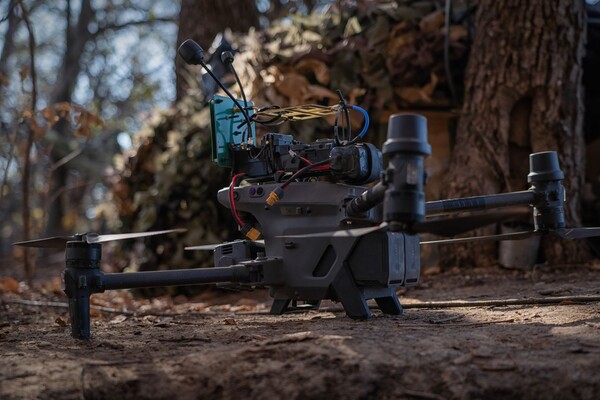
The operation hinged on an airborne communications network using drones. The Financial Times reported that Ukraine launched multiple drones equipped with mesh radios to build a network that relayed signals among them. Each drone served as a communications relay node, extending the link between remote operators and strike drones and missiles. Ukraine adopted, in reverse, a tactic Russia has used for long-range drone and missile attacks on Ukrainian cities.
This enabled operators more than 250 km away to remotely guide drones and missiles. The Ukrainian military moved aircraft while avoiding Russian air defences and precisely targeted structural weak points on the bridge.
Preliminary strikes conducted for weeks ahead of the attack also contributed to the operation's success. Ukraine sequentially destroyed or degraded Russian air defence weapons, radar and electronic warfare equipment deployed to protect the bridge. The attack on the night of Nov. 15 also coincided with Ukraine's largest nighttime drone attack against Russia since the full-scale war began.
A notable point is that Ukraine intentionally excluded Starshield, the military version of Starlink, from the operation. That was because a recent U.S. speed limit measure prevented the use of Starshield for drones and other aircraft exceeding 161 km per hour. President Volodymyr Zelenskiy (볼로디미르 젤렌스키) of Ukraine said the restriction had still not been lifted and was also affecting the operation of some defensive technologies to intercept Russian drones. SpaceX, however, disputed claims that the restriction had been reimposed.
The attack shows Ukraine is developing tactics to reduce reliance on Starlink and use its own communications and drone technology. It is also significant as a case of absorbing Russian tactics and applying them to Ukrainian operations.
The Kerch Strait bridge is a key supply route linking Russia to occupied Crimea. ISW assessed that destroying the bridge would increase difficulties for Russia in maintaining its occupation of Crimea and operating military bases there. The rail section suffered relatively less damage and there are signs train services have resumed, but the collapse of the road section alone makes disruptions to transport of military supplies and troops unavoidable.
The alternative overland supply route is a highway passing through southern Ukraine occupied by Russia. But Ukraine has also attacked that road infrastructure and supply trucks. Concerns have also been raised that debris from the collapsed arch could block passage for large vessels through the Kerch Strait connecting the Sea of Azov and the Black Sea. Russia's burden for maritime supply could also rise.
The attack also carries heavy symbolic weight. After occupying Crimea in 2014, Russia built the Kerch Strait bridge at a cost of about $3.5 billion, or about 4.65 trillion won. President Vladimir Putin (블라디미르 푸틴) of Russia drove a construction truck across the bridge at its opening in 2018, and crossed it again in a Mercedes car in December 2022 after the bridge was damaged by a Ukrainian bomb attack in October that year. The bridge was damaged again in 2025 by mines installed under a pier by Ukraine's security service, but Russia repaired it.
There are forecasts that repairs could take significant time. Building the bridge initially took 2 years, and engineering experts assessed that even under normal conditions restoring the road section could take about 2 years. The timeline could be longer if piers were also damaged. Russia also faces the burden that repair work could be exposed to further Ukrainian missile and drone attacks.
 Seungah Yoo
ysah@d-today.co.kr
Keyword
#Starlink #Starshield #Kerch Strait Bridge #Institute for the Study of War #SpaceX