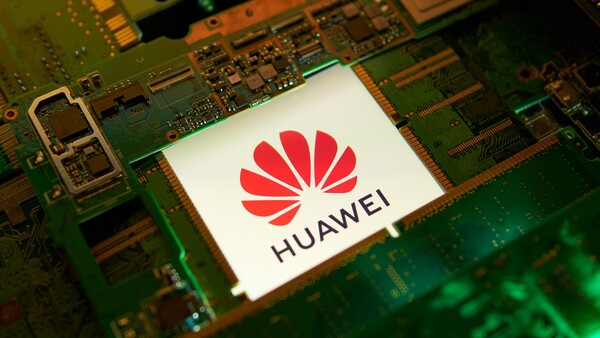
China has started operating a data centre that uses Huawei's latest AI semiconductor, the Ascend 950DT, to provide AI computing services to overseas customers. It is part of a strategy to build its own AI infrastructure in response to U.S. export controls on advanced semiconductors and expand it into global markets.
The South China Morning Post reported on Tuesday that Shantou in China's Guangdong province officially began operating an Ascend 950DT-based AI computing cluster for overseas services on Nov. 13. It is the first time China has moved into a so-called "token export" business using the chip.
The project, introduced as being worth about 1 billion yuan, was jointly pursued by Huawei, state-run Chinese telecoms operator China Telecom and IT services company Guangdong Tianyima. China Telecom provides the telecommunications network and data centre facilities, while Huawei supplies AI semiconductors and computing equipment. Tianyima is responsible for investment and operations.
The core is a token export model in which inference work for AI models is performed in China and the generated results are provided to overseas customers. Tokens are the basic units an AI uses to process and generate text and other content. This means AI computing services can be exported without directly selling high-performance semiconductors overseas.
For this, it uses Shantou's international submarine cable landing station. The structure sends AI inference results processed locally to overseas markets such as Southeast Asia through submarine cables.
Huawei's Ascend 950DT is a next-generation AI accelerator equipped with its self-developed high-bandwidth memory. It has 144GB of memory and bandwidth of 4TB per second, and provides up to 1 petaflop of computing performance based on FP8.
In September, Huawei also pushed ahead in Shanghai with plans to build a liquid-cooled supernode capable of accommodating up to 1,024 accelerator cards, speeding up commercialisation of AI infrastructure.
Moves by Chinese AI companies to adopt domestically made semiconductors are also continuing. Bloomberg reported in September that DeepSeek plans to deploy at least 160,000 Ascend 950DT chips at a data centre in Inner Mongolia. The actual scale and timeline have not been confirmed.
Attention is focused on whether China can reduce its dependence on U.S. advanced semiconductors while securing a new market by exporting AI computing services.
 Jae-won Choi
ittt_0801@d-today.co.kr
Keyword
#Huawei #Ascend 950DT #China Telecom #South China Morning Post #Shantou