
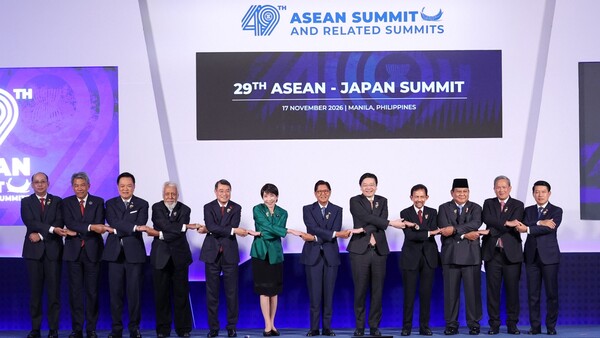
Japan and the Association of Southeast Asian Nations (ASEAN) launched a new cooperation system to jointly respond to security threats stemming from advances in AI technology. They aim to strengthen AI safety and cybersecurity cooperation, while also expanding cooperation in critical mineral supply chains and energy security.
ITmedia, a Japanese outlet, reported on Nov. 18 that Japan's Prime Minister Sanae Takaichi (다카이치 사나에) attended the 29th Japan-ASEAN summit in Manila on Nov. 17 and announced the launch of the "Japan-ASEAN AI Safety and Security Partnership."
The cooperation system was set up to respond to new risks emerging from the rapid development of high-performance AI models. Japan and ASEAN plan to promote AI safety evaluations, information sharing related to cybersecurity and training of specialised personnel.
The partnership focuses on addressing security threats from the malicious use of AI and the possibility of losing human control, while strengthening each country's technological capabilities. It is a voluntary framework without legal binding force, and specific projects will be pursued through future consultations.
They will also strengthen economic security cooperation. The two sides presented securing stable supply chains for critical minerals and energy security as key tasks. The aim is to reduce dependence on specific countries, with supply chain disruption risks such as China's export restrictions in mind.
At the fourth summit of the Asia Zero Emission Community (AZEC) held the same day, participants presented a plan to create an "Asia Oil Security Task Force" to respond to oil supply crises.
Japan will work with the International Energy Agency (IEA) and the Economic Research Institute for ASEAN and East Asia (ERIA) to review a plan for jointly using oil reserves in emergencies. Japan and the IEA also agreed to set up an "IEA-Japan Asia Oil Security Hub" in Tokyo to support the effort.
AZEC participating countries also reaffirmed the "AZEC 2.0" initiative to pursue energy security, economic growth and decarbonisation together.
President Jae-myung Lee (이재명) also attended the ASEAN+3 summit. Participating countries agreed to strengthen cooperation in energy and food security, maritime logistics, disaster response and the prevention of organised crime.
As Japan expands the scope of its cooperation with ASEAN from AI technology safety to core resources and energy supply chains, regional economic security cooperation also appears to be strengthening further.
 Jae-won Choi
ittt_0801@d-today.co.kr
Keyword
#ASEAN #Japan #AZEC #International Energy Agency #ERIA
