
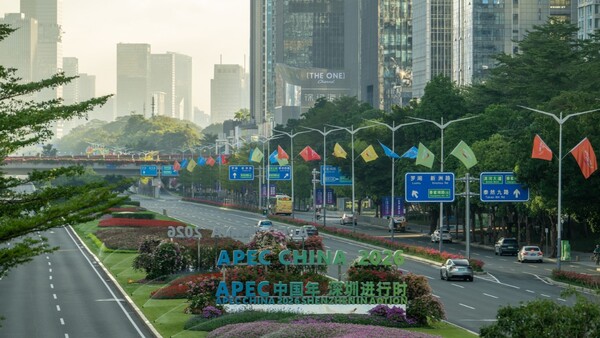
Shenzhen in China is strengthening its status as a global center for technological innovation by promoting robotics, AI and advanced manufacturing. With this year’s Asia-Pacific Economic Cooperation (APEC) leaders’ meeting, it has emerged as a stage to showcase China’s technological capabilities and industrial ecosystem to the world.
On Nov. 18 (local time), the Hong Kong-based South China Morning Post (SCMP) reported that “Robot Valley” in Shenzhen’s Nanshan district has recently seen a steady flow of visits by foreign businesspeople and government officials. European hotel industry representatives looked at cleaning robots, and a park manager from Melbourne in Australia showed interest in adopting robot lawn mowers.
Tuo Liu (투오 리우), who operates the robot platform ROBOTUO, explained that more than 200 robot companies and parts suppliers are concentrated around Liuxian Boulevard in Nanshan district. He said the supply chain is so dense that more than 90 percent of needed parts can be secured within 1 hour.
Shenzhen was once known for assembling low-priced electronic products and producing imitation goods. It has now built up advanced manufacturing and research and development capabilities centered on global technology companies such as Huawei, BYD, Tencent and DJI.
Research and development investment in 2024 totaled 245.3 billion yuan, about 49.1 trillion won, accounting for 6.67 percent of gross regional domestic product (GRDP). Companies covered more than 93 percent of the total. In the World Intellectual Property Organization’s (WIPO) 2026 innovation cluster rankings, the Shenzhen-Hong Kong-Guangzhou region ranked No. 1 in the world for a second consecutive year.
It has recently been accelerating the application of AI in industrial settings. In an implementation plan announced in September, the Shenzhen city government set a goal of expanding the size of the AI core industry to more than 300.0 billion yuan, about 60.1 trillion won, by 2028 and fostering more than 3,000 AI companies.
In robotics, it plans to increase the size of the embodied AI-related industry to more than 100.0 billion yuan, about 20.0 trillion won, by 2027 and raise the number of related companies to more than 1,200.
Still, high housing and business costs stemming from rapid urban development are a burden. Concerns are also emerging that the startup ecosystem, which grew on the back of low-cost housing and manufacturing space in the past, could shrink.
Shenzhen’s case shows the competitiveness of an industrial structure in which research and development, parts procurement, prototype production and mass production are linked within a single region. With this APEC meeting, this innovation model is expected to draw attention in global markets as well.
 Jae-won Choi
ittt_0801@d-today.co.kr
Keyword
#Shenzhen #APEC #South China Morning Post #WIPO #Huawei
