Resource disputes have emerged as an issue at a U.S.-China summit held on the sidelines of the Asia-Pacific Economic Cooperation (APEC) leaders' meeting. China last year also broadened rare earth export controls, only to postpone implementation after a U.S.-China agreement. That has led to speculation that supply chains for critical minerals, including rare earths, could be shaken again depending on the outcome of negotiations.
The APEC leaders' meeting entered its two-day official schedule on the 18th in Shenzhen, Guangdong province, China. The U.S. and Chinese leaders will use the meeting to discuss trade disputes and advanced technology restrictions, then hold their first trilateral summit with Russia. Earlier, the U.S. Commerce Department's Bureau of Industry and Security (BIS) said it would restrict China's remote access to advanced AI semiconductors made by Nvidia and others. The measure is aimed at blocking computing power that reaches China via third-country data centres in Southeast Asia and elsewhere. It follows national security concerns raised after a scandal involving former Nvidia Chief Executive Jensen Huang.
China's rare earth controls have moved in tandem with U.S.-China negotiations. In October last year, China expanded the scope of rare earth export controls to include related equipment and technology, as well as foreign-made products containing at least 0.1 percent Chinese rare earths by value. It then postponed implementation until the 10th of this month under a U.S.-China agreement reached in November the same year.
According to Hanwha Investment & Securities, the export permit system for heavy rare earths and permanent magnets remains in place separately from the postponement. According to Shinhan Securities, China accounts for more than 90 percent of rare earth separation and refining. China also classified cathode materials, precursors, lithium and graphite as areas where it could adjust a "supply chain valve" and use it as leverage, like rare earths.
South Korea's battery industry has prepared by changing the raw material mix used in cathodes. The approach reduces the use of nickel and cobalt and fills the gap with manganese. According to CSF (China Specialist Forum), cobalt reserves are concentrated in the Democratic Republic of the Congo, and dependence on China is high at the processing stage along with nickel. Raw material price trends also align with this direction. According to data compiled by Hana Securities, cobalt prices in September rose 44.5 percent from the same month a year earlier. Over the same period, manganese prices rose 3.7 percent.
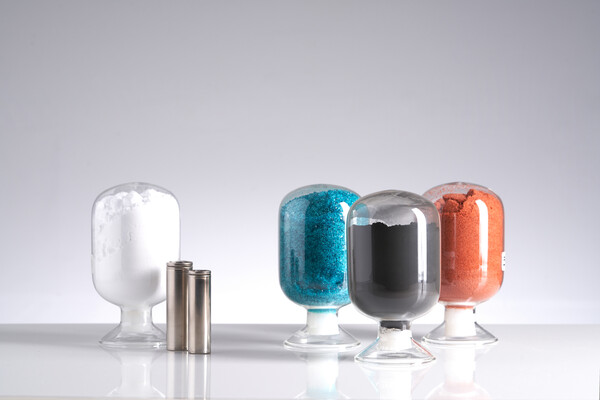
The material that domestic cathode makers are moving fastest on is LMR. LMR is a cathode material that reduces nickel and cobalt and increases the proportion of manganese to deliver higher energy density than lithium iron phosphate (LFP). EcoPro BM said in an earnings announcement early this year that it had completed pilot development of LMR cathodes and was conducting customer verification using samples for the mass production stage. POSCO Future M completed development of LMR cathodes last year and has moved to secure mass production technology.
LG Chem is also producing LMR cathodes at a pilot line in Cheongju, North Chungcheong province at a mass production level and is preparing for commercialisation in 2028. L&F unveiled LMR cathodes as a next-generation product lineup at InterBattery 2026 in March this year.
Such preparations also align with U.S. supply chain requirements. The U.S. government treats batteries as security assets and is scrutinising the origin of key materials. U.S. Transportation Secretary Sean Duffy sent a letter to Ford on Sept. 8 urging it to cut ties with Chinese companies such as CATL and BYD. According to Hana Securities, the U.S. Department of Energy (DoE) said in detailed guidelines for the AMPC that it would provide production subsidies only for batteries with low dependence on China for key materials.
There is an assessment that cathodes with reduced nickel and cobalt use could be a way to meet that requirement. Still, manganese is also a mineral with high supply chain dependence on China. Even if the raw material mix changes, it is difficult to reduce dependence on China at the processing stage.
A variable is that mineral materials could come onto the U.S.-China negotiating table. Hana Securities analysed that the United States is unlikely to open its market to China for battery cells and systems, but cathode materials, precursors, lithium and graphite could become negotiating items because sourcing outside China is difficult in the near term and they do not pose a direct security threat.
As the United States is expected to continue trying to break away from China's mineral supply chains, the conflict phase is also likely to persist. Preparations by South Korean materials companies that have changed raw material mixes in advance are assessed as a means to prepare for supply disruptions from China in either case.
 Seok Dae-geon (석대건)
d2dg@d-today.co.kr
Keyword
#APEC #LMR #Nvidia #POSCO Future M #LG Chem