
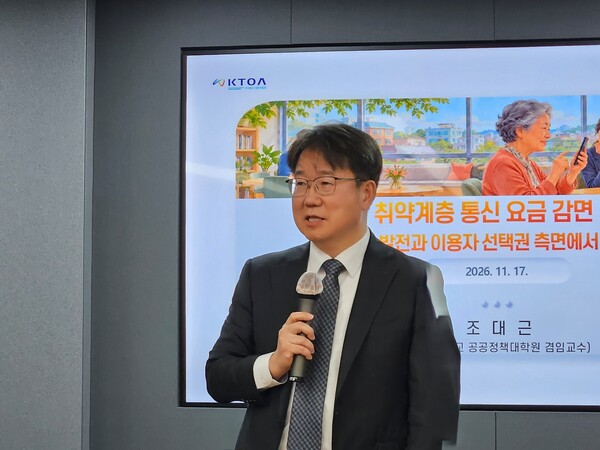
A call has emerged to improve the government-led telecom fee discount programme for vulnerable groups. Critics say the funding structure should be reviewed because the government sets eligibility and discount levels while telecom companies bear the costs. Another view raised was that expanding telecom operators’ no-fault compensation liability for voice phishing losses should be approached cautiously.
The Korea Telecommunications Operators Association (KTOA) held the "9th Telecommunications Industry Insight Seminar" on Nov. 17 at its headquarters in Seoul’s Gangnam district. Presenters that day reviewed recent industry issues and tasks, including the telecom fee discount programme.
◆ Discounts decided by government, costs borne by operators..."social consensus needed"
The telecom fee discount for vulnerable groups is a programme that reduces communications expenses for basic livelihood benefit recipients, near-poverty groups, people with disabilities, national merit recipients and basic pension recipients. The government determines the beneficiaries and discount level as a universal service under the Telecommunications Business Act, but telecom operators cover the actual costs. The policy has reduced communications expenses for vulnerable groups, but the burden on operators is increasing. The total discounts provided by the three mobile carriers last year reached 1.36 trillion won.
The issue was also discussed at a meeting in July between Bae Kyung-hoon, deputy prime minister and minister of science and ICT, and the heads of the three mobile carriers. After the meeting, the three carriers announced additional benefits for young people and vulnerable groups, among others.
Cho Dae-geun (조대근), an adjunct professor at Sogang University’s Graduate School of Public Policy, said the need for support is recognised but the cost-sharing method should be reviewed. He said there was agreement on the goal of supporting vulnerable groups, but insufficient discussion on who should bear how much of the burden.
He also argued that changes in the telecom services environment should be reflected. In the past, access to telecom networks itself was important, but demand for digital use has expanded to devices, content and AI services. Cho said, "From a theoretical perspective, support for vulnerable groups is the state’s responsibility," adding, "The centre of gravity of household spending has shifted from lines to devices and content."
Gaps by group also appeared in experience using AI services. Data presented by Cho showed the AI service experience rate was 59.4 percent among the general public, compared with 36.7 percent for low-income groups, 35.6 percent for people with disabilities and 30.2 percent for older people. Cho said funding should be matched by group after assessing the nature of support and whether the payer is appropriate. For example, basic connectivity could combine telecom operators’ 부담 and general fiscal resources, while digital vouchers for AI and content could be shared by general fiscal resources and digital ecosystem businesses.
Cho likened the current system, in which the government decides beneficiaries and discount levels while specific telecom operators bear the actual costs, to "taxation by regulation". He said a social consensus should be reached in line with the goals of welfare telecommunications and that a sustainable burden-sharing system should be built on that basis.
◆ Caution urged on expanding no-fault compensation for voice phishing..."operators have limited control"
The issue of expanding telecom operators’ compensation liability for voice phishing losses was also discussed. Roh Jin-hong (노진홍), a lawyer at Shin & Kim, presented on discussions to expand no-fault compensation liability for voice phishing victims and introduced telecom operators’ role in preventing fraud.
No-fault compensation is a system that imposes liability for damages regardless of whether an operator is at fault. As voice phishing losses continue, views have been raised that telecom operators should also bear compensation liability. Roh said imposing such liability on telecom operators would be unreasonable. He said even if no-fault liability is imposed, it would be less effective because it would not create new detection technology or legal authority.
He said, "Even if telecom operators provide a delivery path for scam calls or text messages, they have no authority to approve financial transactions or block fund transfers," adding, "Even looking at overseas cases, there are no examples where telecom operators were made to bear no-fault compensation liability for financial fraud losses."
In practice, Singapore designates financial institutions as the primary responsible parties and imposes limited liability on telecom operators only when they violate obligations related to text messages (SMS). Voice phishing in which victims are deceived by phone and transfer money themselves is excluded. Britain also holds sending and receiving financial institutions liable for losses from direct transfers to fraudsters, but does not include telecom operators as parties subject to compensation.
Roh also stressed that domestic telecom operators are already implementing preventive measures, including blocking illegal spam and spoofed caller IDs, suspending the use of numbers used for crime, and AI-based fraud detection and warnings.
According to the National Police Agency, the number of voice phishing cases in January to August this year fell 48.8 percent from the same period a year earlier to 8,584. The amount of losses also dropped 56.3 percent to 387.1 billion won. Emergency blocking of phone numbers used for crime, introduced in November last year, was carried out about 119,000 times through August this year.
Roh also raised concerns that checking call content to avoid compensation liability could conflict with principles protecting the secrecy of communications. He said, "Telecom operators' fundamental duty is to provide stable networks," adding, "The structure should be that telecom operators play a preventive role such as verifying subscribers and blocking criminal lines."
Meanwhile, Lim Seung-jun (임승준), a lawyer at Lee & Ko, presented measures to boost investment in AI data centres. He said that although an investment tax credit scheme for AI data centres has been introduced, it has not led to practical use because there have been no cases of passing the technology review. He said investment in AI data centres should be supported through a future response fund, special zone subsidies and exemptions from power grid impact assessments, among other measures.
 Jin-ho Lee
jhlee26@d-today.co.kr