
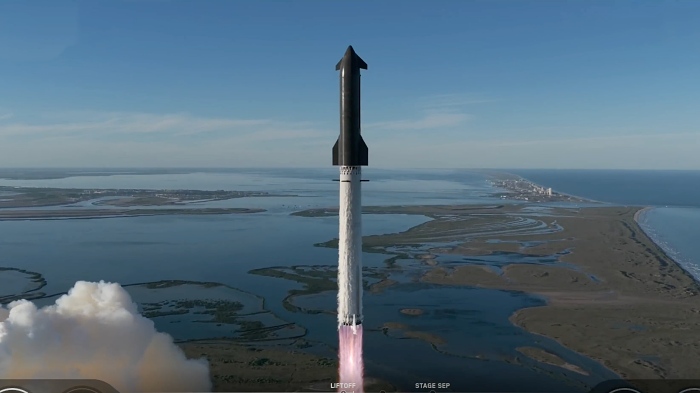
SpaceX’s large Starship spacecraft has succeeded in being recovered by the launch tower, drawing attention to the possibility of crewed flights. Even so, analysts say the first mission to carry people on Starship is likely to be a moon-landing mission, not a flight that departs Earth and returns to Earth. A crewed flight that lifts off from Earth and lands back on Earth could be pushed beyond 2030, possibly to the mid-2030s.
On Nov. 16, space news outlet Ars Technica reported that the Starship upper stage was caught and recovered by the launch tower’s mechanical arms after completing its flight. The development marks an important step toward a system for rapidly reusing Starship. In the same flight, however, the Super Heavy booster failed to be recovered by the launch tower and splashed down in the Gulf of Mexico. The vehicle and booster were not both recovered.
Starship’s first crewed flight is likely to be a NASA lunar exploration mission. Astronauts would launch from Earth aboard NASA’s Orion spacecraft and dock with Starship in orbit. They would then transfer to Starship, land on the moon, lift off from the moon and return to Orion before heading back to Earth.
NASA signed a contract with SpaceX in 2021 to develop Starship as a moon lander called the Human Landing System. The crewed lunar landing target, set for 2024 at the time, has been delayed to 2028, and uncertainty over feasibility remains. The recent success in recovering the upper stage could help increase launch frequency, raising the possibility that a crewed lunar landing using Starship could be achieved within the 2020s.
Even so, the schedule depends on how much priority SpaceX places on developing the crewed lunar lander. SpaceX is currently seen as focusing more on revenue-generating businesses such as launching Starlink satellites and data-center satellites under a future StarMind initiative.
A crewed flight returning to Earth is far more complex than a moon landing. A lunar lander does not need to withstand the extreme heat of re-entry into Earth’s atmosphere or perform the flip manoeuvre and propulsive landing required for returning to Earth. By contrast, a crewed Starship landing on Earth must prove it can safely carry out all of those steps with passengers aboard.
Safety systems are also a challenge. Starship has no launch escape system that separates the crew from the rocket in an emergency. NASA applies strict human safety certification requirements to spacecraft carrying astronauts, but the U.S. Federal Aviation Administration does not directly certify passenger safety on commercial spacecraft. Instead, it regulates around passenger risk disclosure and consent and protecting the safety of people who are not on board.
If SpaceX reaches a level where it can repeatedly launch Starship reliably, it may also pursue its own crewed flights. Potential customers say the company is also developing a crewed Starship derivative model capable of sending dozens of people to the moon. The pressurised living space of a single Starship lunar lander was reported to be larger than the total pressurised living space of the International Space Station.
But commercial human spaceflight is likely to require significant time to develop and operate and to be less profitable than launching Starlink satellites. The risk that an accident could cause loss of life is also a major burden for a company. Operators of private space stations have proposed using Starship for crew transport, but SpaceX is reported to have shown no interest.
Taken together, these factors suggest Starship is likely to carry people and land on Earth after 2030.
 Seung-a Yoo
ysah@d-today.co.kr