
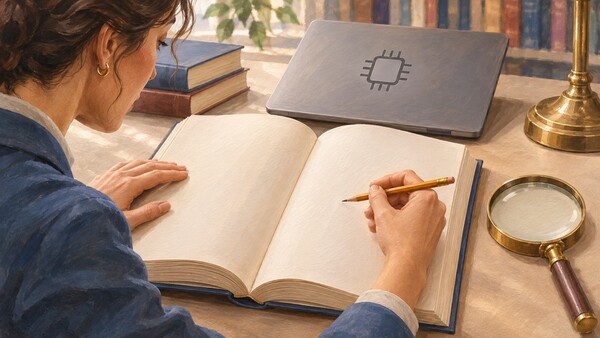
As AI rapidly spreads through novel writing and the publishing process, confusion is growing in the literary world. As works made with AI pour out, disputes are taking shape over copyright protection, how to determine whether a work is genuine and what standards should apply to publication.
On Nov. 16, Japanese media outlet Gigazine cited Britain's The Guardian in introducing an analysis that AI is changing how writers create but the publishing industry's response system is failing to keep up with the pace of technological development.
A leading example is romance novelist Coral Hart. Hart said she has published 370 novels under 21 pen names using AI since 2025. In a past interview, Hart also explained that she completed a book in about 45 minutes.
Use of AI is spreading to other writers as well. In a survey of 1,229 writers by publishing marketing platform BookBub, 45 percent of respondents said they use AI in their work.
Among writers who use AI, 81 percent said they use it for research. They also used it widely to build plots and write marketing materials. However, 74 percent of writers who use AI were found not to disclose it to readers.
In the publishing market, AI-generated sentences make up a significant share. Researchers at Stony Brook University in the United States analysed 14,419 self-published genre novels released on Amazon from 2023 to 2026. They detected suspected AI-generated text exceeding 25 percent of the total length in about 20 percent of the books. The study has not yet undergone peer review.
Backlash is also strong. Anthropic reached a $1.5 billion settlement in a class action lawsuit alleging it obtained writers' works without authorisation, and received final court approval in July this year.
Publishers' standards are also under dispute. U.S. publisher Hachette cancelled the U.S. release of the horror novel "Shy Girl" in March after allegations of AI use were raised. The author, however, denied allegations that the book was written directly using AI.
Hannah Bowman (한나 보우먼) of the Association of American Literary Agents said, "You must not condemn a writer based only on AI detection results." She added, "Authors who face allegations should be given sufficient opportunity to explain."
Copyright is also a point of contention. The U.S. Copyright Office says AI-assisted works with sufficient human creative contribution can be protected, but expressions generated independently by AI are in principle not eligible for protection.
In the publishing industry, calls are growing to clearly define the scope of AI use, disclosure obligations and verification procedures.
 Choi Jae-won
ittt_0801@d-today.co.kr