
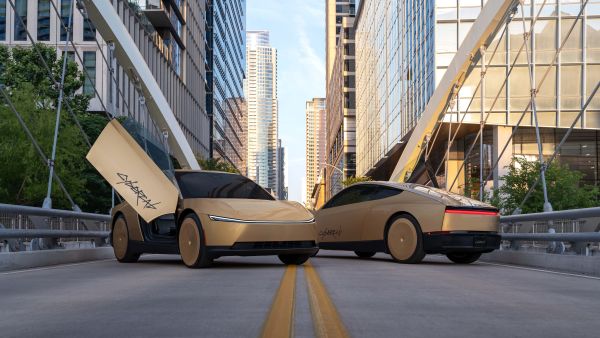
Tesla will invest 3 billion euros, about 4.42 trillion won, in its Giga Berlin factory near Berlin, Germany, to expand production facilities for the robotaxi “Cybercab”. It plans to start production in 2029 and eventually produce up to 1 million units a year. In Europe, regulatory approval for large-scale operation of driverless vehicles has yet to be resolved, prompting criticism that there is a gap between the investment size and the feasibility of commercialization.
On Nov. 16, Tesla announced it would build new production facilities at its Giga Berlin plant in Gruenheide, Germany. The funding will go to a production hall and auxiliary buildings to be built north of the existing factory, as well as a second wastewater treatment facility. Tesla plans to apply for construction permits by the end of this year, break ground in the first half of 2027 and begin Cybercab production in 2029.
The new facility has a target production capacity of up to 1 million units a year. That is the plant’s design capacity, not actual output. Tesla also set out a goal of building the facility into the world’s most technologically advanced factory.
The issue is Europe’s regulatory environment. The European Union has a system for type approval of fully driverless vehicles, but under the current small-series production approval framework, annual registrations are limited to 1,500 per vehicle type. Rules related to automated valet parking were revised in March, but an approval framework that would allow robotaxis to operate on a large scale has not yet been established.
Tesla’s existing driver-assistance system also differs from fully driverless driving. The Netherlands Vehicle Authority (RDW) approved Tesla’s “Tesla Assisted Driving,” but drivers must continuously monitor driving conditions and remain responsible for driving. An approval process that applies across the EU is also under way. The Cybercab, which has no steering wheel or pedals, must obtain a separate approval for driverless vehicles from assisted-driving systems that require driver supervision.
Tesla could also consider exporting vehicles produced in Germany to regions outside Europe. But the goal of up to 1 million units a year is relatively aggressive compared with the current scale of its robotaxi business. Tesla is also expanding Cybercab production and robotaxi operations in Texas, but large-scale commercial operations have not yet become established.
The investment shows Tesla is placing greater weight on autonomous driving and robotaxis beyond traditional car manufacturing. The extent to which Europe’s driverless-vehicle approval system changes by the time mass production begins in 2029 is seen as a key variable for business expansion.
 Seung-a Yoo
ysah@d-today.co.kr