
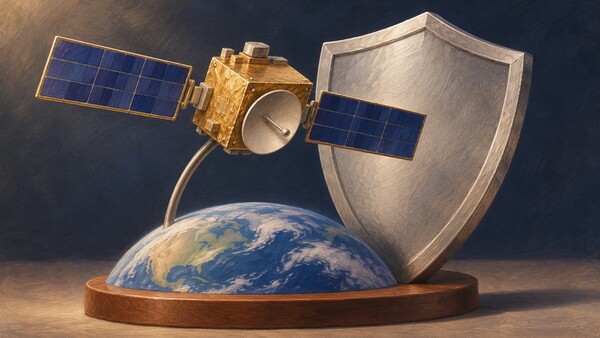
[DigitalToday reporter Jae-won Choi] U.S. intelligence has forecast that China could deploy directed-energy weapons such as lasers in space in the late 2020s, threatening satellites operated by the United States and its allies. Military tensions over outer space are rising after Russia was also seen maneuvering a military satellite close to a Western commercial satellite.
Defensa recently reported that the U.S. Defense Intelligence Agency (DIA) released its “2026 Space Security Threat Report,” analysing trends in Chinese and Russian development of anti-satellite weapons.
The DIA assessed that China has already deployed laser weapons of various power outputs on the ground and could disrupt or damage the functions of low-Earth orbit satellites. It forecast that by the late 2020s China could also secure space-based directed-energy systems and high-power ground weapons.
Directed-energy weapons use lasers or high-power electromagnetic waves to disrupt or damage satellite sensors and electronic equipment. It has not been confirmed, however, that China is operating space-based weapons.
Russia’s close satellite maneuvers have also heightened concerns about space security. The Russian military satellite “Kosmos 2612” approached the U.S.-registered commercial radar satellite “ICEYE-X36” last month.
ICEYE is a company that provides satellite imagery to Ukraine. Space tracking company LeoLabs assessed that the two satellites came within about 500 metres. Other analysis raised the possibility the distance narrowed to tens of metres, but the exact minimum distance has not been confirmed.
China’s reconnaissance satellite capabilities are also expanding rapidly. According to the DIA, as of July this year, China’s intelligence, surveillance and reconnaissance (ISR) satellites exceeded 510, more than tripling from 2018.
In 2022, China also used its Shijian-21 satellite to move an end-of-life BeiDou navigation satellite into another orbit. The move was a space debris removal technique, but was assessed as an ability that could also be used to approach and capture other satellites.
The United States has also moved to respond. The U.S. Space Force is pursuing sustained orbital manoeuvres and the ability to refuel and service satellites. In September, it officially acknowledged for the first time that it has weapons for space control in orbit.
Satellites are essential infrastructure not only for military reconnaissance but also for civilian economic activity such as communications, navigation and finance. As major countries expand competition over anti-satellite weapons, the safety of commercial space infrastructure and the establishment of space security norms are emerging as new challenges.
 Jae-won Choi
ittt_0801@d-today.co.kr