
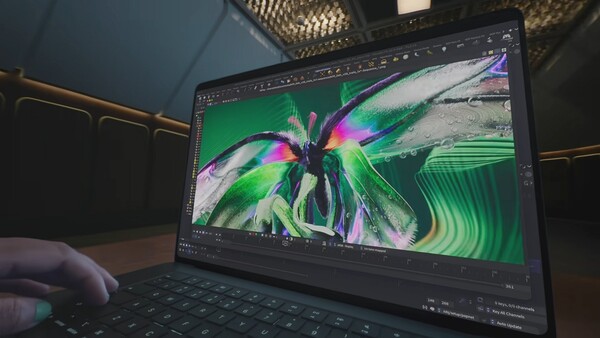
Cases are mounting of users complaining of eye fatigue, headaches and dizziness on Apple’s newly released OLED MacBook Pro. As screen flicker generated during brightness adjustment is being cited as a cause, controversy is growing over the display’s ease of use.
Gigazine, a Japanese media outlet, reported on Nov. 16 that some users of the new MacBook Pro released on Nov. 6 posted on online communities such as the MacRumors forum and Reddit that they experienced eye fatigue, headaches and nausea.
The new MacBook Pro uses a PROLED XDR display instead of the previous mini LED. It applies tandem OLED technology that stacks two OLED emissive layers, delivering peak partial brightness of up to 2,000 nits and a 10 million-to-1 contrast ratio. It also supports touch controls for the first time on a MacBook Pro.
Some users, however, said they find it difficult to use for long periods despite the sharper screen than earlier models. In a poll on the MacRumors forum, about one-third of respondents said they felt discomfort when using the display. The poll was voluntary, so it cannot be generalised to all users.
Pulse-width modulation, or PWM, a screen brightness control technology, is being cited as a cause. PWM adjusts brightness by rapidly turning the screen on and off, which may cause eye fatigue or headaches for people sensitive to flicker.
Notebookcheck, an IT-focused outlet, tested the new 14-inch MacBook Pro and measured 240 Hz flicker at screen brightness levels below 99 percent. The PWM amplitude, which indicates the range of brightness fluctuation, was 56 percent.
By contrast, the flicker frequency of the M4 Pro MacBook Pro with a mini LED display measured 14,880 Hz. That makes the new model’s frequency about 1/62 of that level.
The new product also applies DC dimming, which controls brightness by adjusting current levels. Even when that technology was operating, 240 Hz flicker was confirmed.
Some users who had no issues using OLED iPhones or iPads also reported discomfort with the new MacBook Pro. One user who bought the 16-inch model said dizziness led the user to return the product in less than a week.
Apple provides a "Display Pulse Smoothing" function on some iPhones to reduce screen flicker. But macOS does not yet have the same function, drawing attention to the possibility of software improvements.
It has not been confirmed whether PWM is the direct cause of all the symptoms. Apple has not announced any official improvement plan.
 Choi Jae-won
ittt_0801@d-today.co.kr