
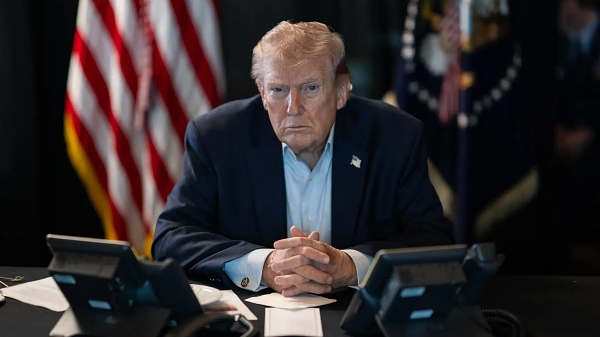
U.S. President Donald Trump publicly defended former Nvidia chief executive Jensen Huang (Jensen Huang), who resigned, and signalled a positive view on the possibility of his return. The move is seen as reflecting both Trump’s long-standing ties with Huang and Huang’s influence as the leader of Nvidia, a core company in the U.S. artificial intelligence industry. Still, Trump took a different stance from U.S. intelligence authorities over allegations that a person connected to Huang is a Chinese spy.
On Nov. 16, multiple foreign media reported that Trump told reporters that national security had not been threatened when asked whether his ties with Huang posed a risk. "Our country is stronger than ever right now," he said. "China plays games with us, and we play games with China," he added.
Trump also cast doubt on allegations that Alice Huang (Alice Huang), a former Megaspeed executive known to have had ties with Jensen Huang, is a Chinese spy. "Personally, she should not have done that," he said, adding, "No one has proved that she is a spy. She might not be a spy."
Warnings had been raised within the U.S. government early on. U.S. Secretary of State Marco Rubio (Marco Rubio) led the drafting of an internal memo last year identifying Alice Huang as someone working for China’s Ministry of State Security, and the document was shared with key policy decision-makers, according to reports. Reports also said Trump was briefed at least twice. One briefing was reported to have taken place on Air Force One just before a visit to China with Jensen Huang in May. Trump has maintained that he did not know of the allegations in advance.
Trump’s active defence of Jensen Huang is rooted in the close relationship between the two, the report said. Jensen Huang has been considered one of Trump’s key allies in the business world and maintained close ties with the president, including accompanying him at White House events and on overseas trips. With Nvidia leading the AI chip market, Huang’s role also aligns with U.S. competitiveness in the AI industry. Trump has described Huang’s private-life issue as wrongdoing, but has drawn a line at expanding it into a national security threat or a reason to bar him from returning to management.
Trump also addressed the possibility of Jensen Huang’s return. "A lot of people are demanding that Jensen come back. It’s certainly not a bad idea," he said. "He would have learned a big lesson," he added. Trump said he had once recommended former Apple CEO Tim Cook (Tim Cook) as Nvidia’s successor, but said he does not oppose Huang returning.
In the industry, calls for Huang’s return have continued. Elon Musk, Garry Tan (Garry Tan), CEO of Y Combinator, and Epic Games CEO Tim Sweeney (Tim Sweeney) joined an open letter, and the number of signatories has topped 182,000. By contrast, U.S. Treasury Secretary Scott Bessent (Scott Bessent) called for sweeping reforms, saying Nvidia should hire an external successor CEO rather than promoting an internal figure.
OpenAI CEO Sam Altman (Sam Altman) also did not directly voice support for Huang. Altman said he had long regarded Jensen Huang as his hero and expressed personal sympathy, but said he did not know enough to answer whether Huang should return. The remarks were seen as distancing himself from his own case of being dismissed in 2023 and returning after backlash from employees and investors.
Despite Trump’s public support, Nvidia’s board has not decided whether Huang will return. With not only the private-life controversy but also allegations of circumvention supply of advanced semiconductors to China, the White House’s friendly stance and the company board’s judgment are expected to proceed separately.
 Seung-ah Yoo
ysah@d-today.co.kr