
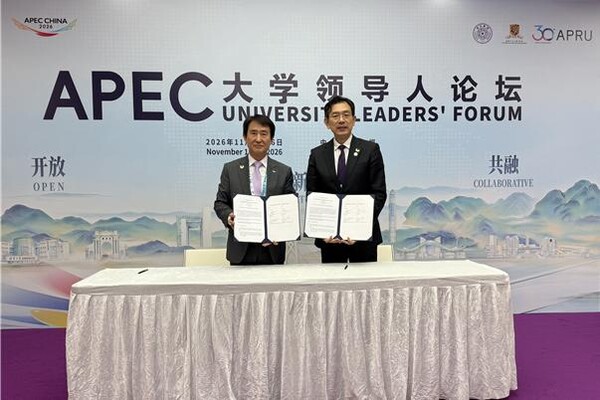
A path is opening for students at the Korea Advanced Institute of Science and Technology (KAIST) and Tsinghua University to earn master's degrees from both institutions.
KAIST said on Nov. 17 it signed an agreement with China's Tsinghua University to establish a double-degree master's programme in mechanical engineering.
An agreement signing ceremony held on Nov. 16 at the Chinese University of Hong Kong in Shenzhen was attended by KAIST President Chung-sik Bae (배충식) and Tsinghua President Luming Li (리루밍). Under the agreement, master's students in mechanical engineering will study for 1 year each at KAIST and Tsinghua. If they meet academic and research requirements set by the two universities, they can obtain master's degrees from each institution.
The two universities will select about 5 students each year starting from the fall 2027 semester and support research in areas including advanced manufacturing, robotics engineering, and energy and mobility. They will later expand cooperation to joint faculty research, exchanges in doctoral programmes and short-term research training.
The agreement was reached on the occasion of the APEC University Leaders Forum (AULF) 2026, held for 2 days from Nov. 15 in Shenzhen, China. The forum is an event where presidents of major universities in the Asia-Pacific region and corporate and government officials discuss measures for cooperation in education, research and innovation.
Bae attended as a speaker and introduced KAIST's start-up support system and achievements. According to Bae, after KAIST simplified procedures for faculty start-ups, the annual number of faculty start-ups increased from fewer than 5 cases to about 15 cases.
For students, it allows start-up leave of absence without a time limit and recognises start-up activities for regular academic credits. From 2021 to 2025, the number of companies started at KAIST was 568. In the same period, 24 KAIST-related companies were listed.
Bae proposed tasks for cooperation among Asia-Pacific universities, including support for one-person start-ups using AI agents, international expansion of KAIST's start-up education programme E5 KAIST, and support for climate-tech start-ups that scientifically verify carbon-reduction effects.
Bae said, "This double-degree programme connects the trust the two universities have built into an educational opportunity that students can experience," and added, "We will develop student exchanges into joint research and broaden cooperation with Asia-Pacific universities so that research outcomes lead to start-ups and investment."
Li said, "KAIST and Tsinghua have complementary strengths in mechanical engineering," and added, "I hope young engineers from the two countries will learn and research together and grow into talent that will lead innovation in the Asia-Pacific region."
Separately, during the forum, the KAIST delegation visited major innovative companies in Shenzhen such as Tencent and BYD, as well as Tsinghua's Shenzhen campus and the Chinese University of Hong Kong, to discuss ways to expand industry-academia cooperation and exchanges between universities.
 Jin-ho Lee
jhlee26@d-today.co.kr