
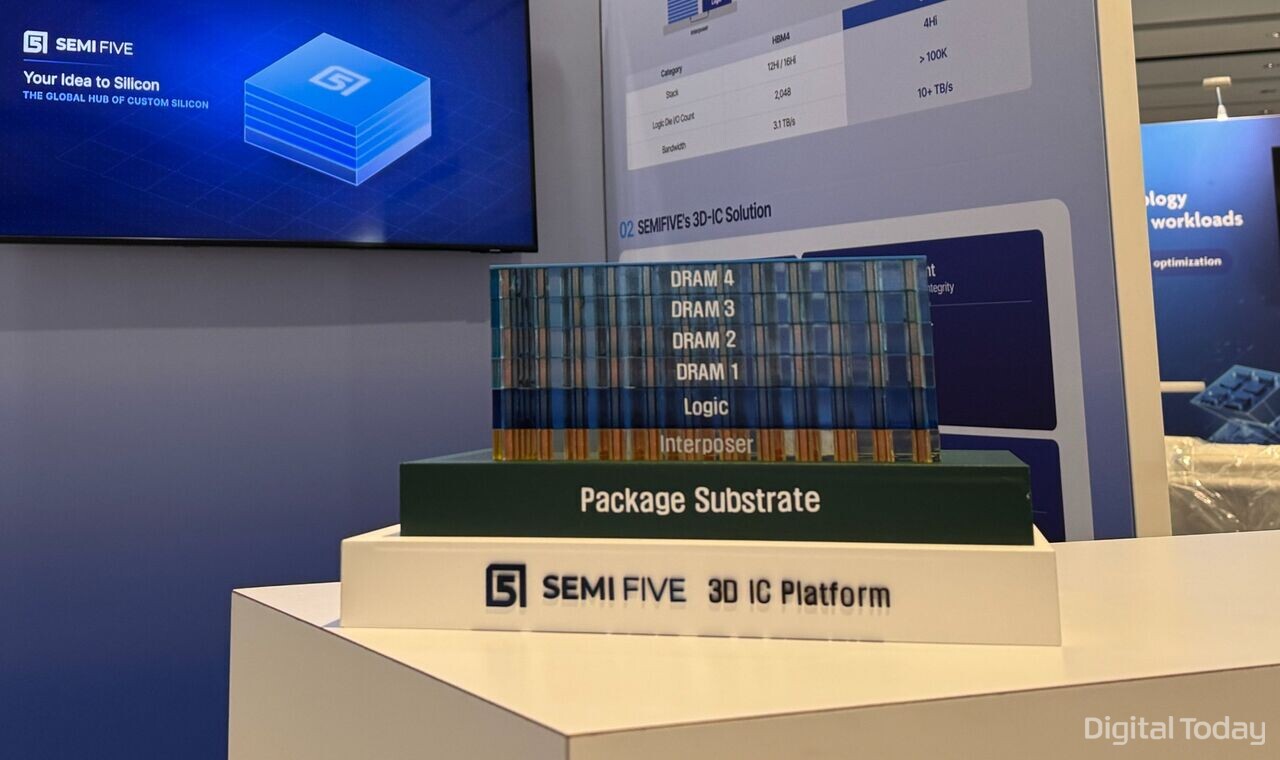
SemiFive said on Nov. 17 it unveiled its in-house 3D-IC specialised platform solution at SC26 in Chicago. The 3D-IC platform stacks logic chips and DRAM vertically. It is a technology the company invested in pre-emptively to prepare for a surge in demand for ASICs, custom semiconductors designed for specific purposes.
Unlike HBM, which connects memory horizontally alongside a logic chip, 3D-IC stacks DRAM on top of a logic chip. Hundreds of thousands of physical channels are created between the two chips, enabling higher effective bandwidth than HBM. With a shorter data travel distance, power consumption per bit falls without having to raise frequency. The company said not using an interposer, a component that connects chips, also reduces packaging uncertainty and manufacturing costs.
SemiFive's 3D-IC specialised platform under development will be first applied to the MN-Core L2000 series from Japanese AI company Preferred Networks (PFN). SemiFive is a turnkey solution partner for the series, handling everything from design to mass production supply. It also manages the supply chain, spanning DRAM suppliers, foundries, bonding, packaging and testing. The company said it addressed challenges such as heat control, power architecture and yield management by optimising technology with partners.
MN-Core L2000 is currently scheduled for tape-out in the first quarter of 2027, a stage in which design is completed and production begins. The company said inference speed and energy efficiency are expected to improve from the earlier MN-Core L1000 model. It is expected that 3D-IC will help offset HBM supply constraints in dedicated AI semiconductors for defined uses and will also be used in edge devices such as on-device AI, robotics and smart devices.
Daisuke Okanohara (오카노하라 다이스케), PFN co-founder and CEO, said, "The MN-Core L2000 series is a next-generation AI chip designed to provide much better memory bandwidth than the MN-Core L1000 series, and another step forward to overcome the bandwidth limitation, a key bottleneck in generative AI." He added, "Developing AI chips with a 3D stacking structure comes with more complex technical challenges than existing chip development in terms of power consumption, heat dissipation and manufacturing yield, among other factors."
He added, "Together with SemiFive, which has a proven track record in turnkey solutions for custom semiconductors, we will resolve these technical difficulties and overcome the challenges AI faces today."
 Dae-geon Seok
d2dg@d-today.co.kr