
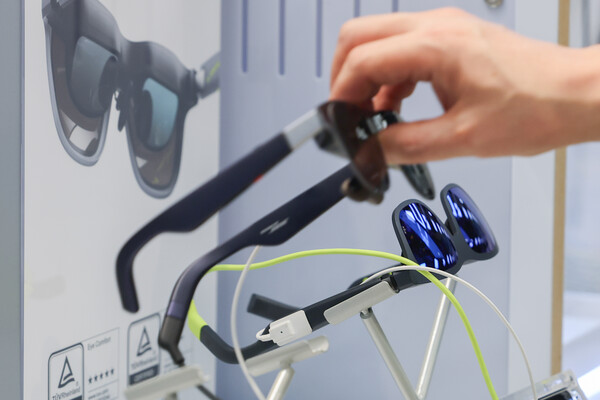
As cheating using advanced devices such as AI smart glasses continues, the need for responses by industry and the government is growing. With concerns rising ahead of the College Scholastic Ability Test, critics say existing visual checks and restrictions on bringing electronic devices into test sites have limits.
Related ministries and the industry say cases of cheating using AI smart glasses have recently been emerging from school tests to national qualification exams.
AI smart glasses are wearable devices that collect surrounding information with cameras and microphones and provide analysis results through AI services. They initially focused on photo and video shooting and voice guidance, but have recently evolved to display various information directly by mounting a display on the lens.
A full survey released by the education ministry on Nov. 9 found 4 cases of cheating related to AI smart glasses in middle and high school assessments nationwide this year. In national qualification exams overseen by the Korea Human Resources Development Service, 6 related cases occurred through the end of October this year.
The controversy has grown after the top scorer in a certified tax accountant exam admitted cheating using AI. The test-taker cheated by photographing exam questions with an ultra-small camera on Nov. 15 and obtaining answers through a smartphone and generative AI. AI smart glasses were not used directly, but critics say countermeasures are urgent as cheating using advanced devices continues. The Nov. 19 sitting of the 2027 school year College Scholastic Ability Test has also put test-site management on alert.
KCA to pursue development of AI smart-glasses detector; emergency countermeasure meeting at Cheong Wa Dae
As the situation has grown more serious, the government is speeding up efforts to prepare countermeasures. The Korea Human Resources Development Service has been placing 221 dedicated supervisors, called "AI inspectors", at national qualification test sites since Oct. 25 to intensively monitor cheating involving AI smart glasses and other devices.
The education ministry said in a National Assembly briefing on Nov. 16 it will place at least 1 dedicated staff member at each of the country’s 1,312 college entrance exam sites to identify smart glasses. It also plans to distribute additional guidance materials containing tips for determining cheating involving ultra-small cameras and other devices.
At a countermeasure meeting chaired by Prime Minister Han Sung-sook (한성숙) on the same day, officials decided to push for the collection of all types of smart devices and the blocking of public WiFi on exam day. The government plans to thoroughly check for and inspect abnormal signs during exams and, if cheating is confirmed, to cancel passing results, restrict eligibility to take exams and request investigations.
Technical responses are also being pursued. The Korea Communications Agency (KCA), under the Ministry of Science and ICT, previously placed an order for a project to develop radio-wave detection equipment for AI smart glasses. The project aims to develop portable detection equipment that analyses Bluetooth and WiFi signals to determine the presence of AI smart glasses and whether they can be used.
After the equipment is developed, KCA will verify detection performance in an environment similar to actual test sites. The Ministry of Employment and Labor and the Korea Human Resources Development Service will review adopting the detection equipment being developed by KCA and will prepare a comprehensive plan to prevent cheating in national qualification exams within this year.
The Ministry of Science and ICT also plans to establish related policies based on policy research. Through a project titled "Research on measures to revitalise industry by creating a desirable AI-glasses usage environment", it will analyse domestic and overseas market and technology trends and prepare measures to prevent side effects. The Personal Information Protection Commission released a report on Nov. 9 analysing the risk of personal information violations by AI smart glasses and said it will prepare guidelines for manufacturers and service providers within this year.
Limits remain for detection technology alone; on-site application and institutional improvements are tasks
Still, some say more advanced countermeasures are needed as cheating has already become a reality. At last month’s parliamentary audit by the Science, ICT, Broadcasting and Communications Committee, lawmakers pointed to the problem that policy research results from the Ministry of Science and ICT would not be available until next summer. The effectiveness of detection technology is also a task. Even if wireless communication signals are detected, it is difficult to verify whether an AI service was actually used, and false detections may occur in the process of distinguishing devices from other wireless equipment. Another limitation is that even if a signal is detected, it is not possible to immediately confirm how the device was used.
Work is also needed to link response systems across government ministries. Even if the Ministry of Science and ICT develops detection technology, related ministries such as the Ministry of Education and the Ministry of Employment and Labor, which manage actual tests, must have common standards and operating procedures to use it. A system is also needed to supplement detection technology whenever new devices emerge.
Concerns about illegal filming also remain. At the parliamentary audit, Democratic Party lawmaker Lee Jeong-heon (이정헌) conducted a demonstration on distinguishing ordinary glasses from AI smart glasses. Lee pointed to insufficient government response in a situation where the potential for misuse in illegal filming is high, including the distribution of stickers that cover recording indicator lights.
The industry says AI smart glasses could be misused not only for cheating in exams but also for illegal filming and personal information violations, among other problems, and calls for technical responses and institutional improvements in parallel. It says misuse should be blocked without hindering industry revitalisation.
An industry official said, "AI smart glasses are developing quickly, and communications differ by device, so it is difficult to prevent all cheating with a single piece of detection equipment." The official added, "It is important to establish management standards and response procedures by testing institutions while also advancing detection technology."
 Jin-ho Lee
jhlee26@d-today.co.kr