
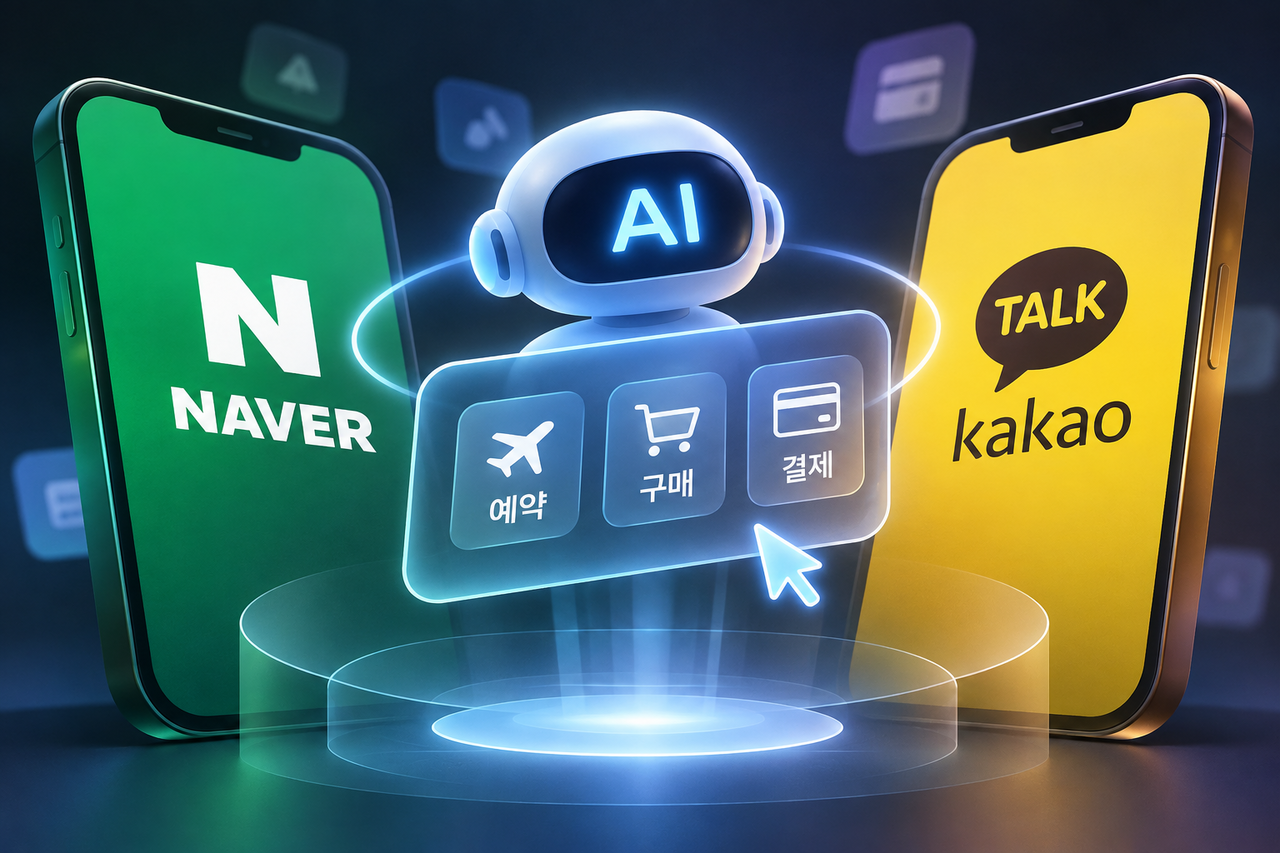
Naver and Kakao are expanding the scope of AI agents to external services as they compete to secure user touchpoints and control transactions.
Industry sources said on Monday the two companies laid out strategies on recent third-quarter earnings conference calls to connect everything from information search to booking, purchases and payments through AI agents.
While existing AI services focus on answering questions or recommending information, AI agents are designed to carry out actual tasks on behalf of users. Instead of users finding a reservation site after getting a restaurant recommendation, the AI would proceed with the reservation process. To do that, the two companies are preparing functions that connect not only their own services but also external websites.
Naver leans on search and payments, Kakao on conversational context
Naver plans to release a personal AI agent app within this year. While its existing AI tab strengthens search and answer functions, the new agent will focus on handling real tasks on behalf of users.
It plans to link its own services such as shopping, Place, reservations, maps and Naver Pay, and use search, reviews and transaction history to help user requests lead to actual purchases or visits.
Naver said its existing shopping AI agent is already showing results. It said in September the number of shopping AI agent users rose about fivefold from March, while transaction volume increased about fourfold. In the fourth quarter, it plans to pilot a function that enables users to proceed to payment within the agent.
It is also pushing to connect to external services. The AI will handle tasks by operating external websites in a separate browser environment, and it plans to gradually expand direct integration through official partnerships.
Naver CEO Choi Soo-yeon (최수연) said on a conference call on Nov. 12, "Even if it works based on browsing at first, later we aim to make faster and more reliable connections based on partnerships."
It is designed so that users make the final decision on payments or confirmed reservations, and so that actions such as sending emails or adding schedules require confirmation before execution.
Kakao has positioned KakaoTalk as the centre of its AI agent. A representative example is "Kanana Space," which will run a pilot for pre-registered users in December.
Kanana Space is a service in which AI carries out tasks when users make requests by voice or text in KakaoTalk. It will start with Kakao services such as changing KakaoTalk settings, gifting and remittances, and later expand the scope to external services.
Kakao says its strength is conversational context. Within the scope of user consent, it plans to use on-device AI models and other tools to identify promises, schedules and interests in conversations and connect them to actual tasks.
Kakao has also been pursuing external integration for its existing AI services. In September it added seven external partners to "KakaoTools" under "ChatGPT for Kakao," expanding the number of linked partners at the time to 10. It said this is performance for a separate service from Kanana Space.
While Naver highlights transaction-related services such as search, shopping and payments, Kakao is putting weight on identifying user needs from everyday conversation and linking them to actual service use.
External service links are key, with costs and revenue sharing also challenges
There are two main ways to link to external services. One is for the AI to directly call needed functions in cooperation with service providers. The other is for the AI to open a web browser and manipulate the screen.
Direct integration allows fast and stable task processing but requires cooperation from the other company. Browser control can access a wide range of services without separate partnerships, but it carries higher computing costs and requires improvements in task success rates and stability. Some companies may also restrict AI access.
Kakao said that as it pursued direct integration with external companies, obstacles included development staff, schedules and coordination of interests. It chose a strategy of first checking demand for use across various services through browser control, then directly connecting major services with providers. Naver is also pursuing both browser control and official partnerships.
In particular, Kakao disclosed cost differences depending on the integration method. Kakao CEO Jeong Shin-a (정신아) said on a conference call on Nov. 5 that if payment is carried out through a browser, AI model call costs could be about 800 to 900 won per case, but could fall to about 5 won by using A2A and MCP, technologies for direct connections between services.
Linking to external services also ties into monetisation strategies. If AI does more than recommend products and connects users to actual transactions, opportunities for advertising and brokerage revenue could expand.
Naver plans to expand advertising billing standards from clicks to actual transaction results as it broadens AI services. It aims to expand beyond shopping and Place into industries where transactions occur externally, such as finance and insurance and automobiles, and plans to pilot a deal-conclusion advertising model in the first half of next year.
Kakao is also planning a new advertising model that recommends products and services by using interests and purchase intent identified through interactions between AI and users. The strategy is to secure demand similar to existing search ads within KakaoTalk.
However, it has not disclosed specifics on what revenue models platforms and service providers will apply, or how they will share revenue, for transactions generated through integration with external services. For external companies, new user inflows through AI are an opportunity, but if users consume services without going through individual apps or websites, interests in securing customer touchpoints could also shift.
An industry official said, "The AI agent race will ultimately lead to the question of who connects a user's request to an actual transaction," and added, "As links to external services expand, a key challenge will be how platforms and service providers share revenue arising from user inflows and transactions."
 Lee Ho-jung
lhj@d-today.co.kr