
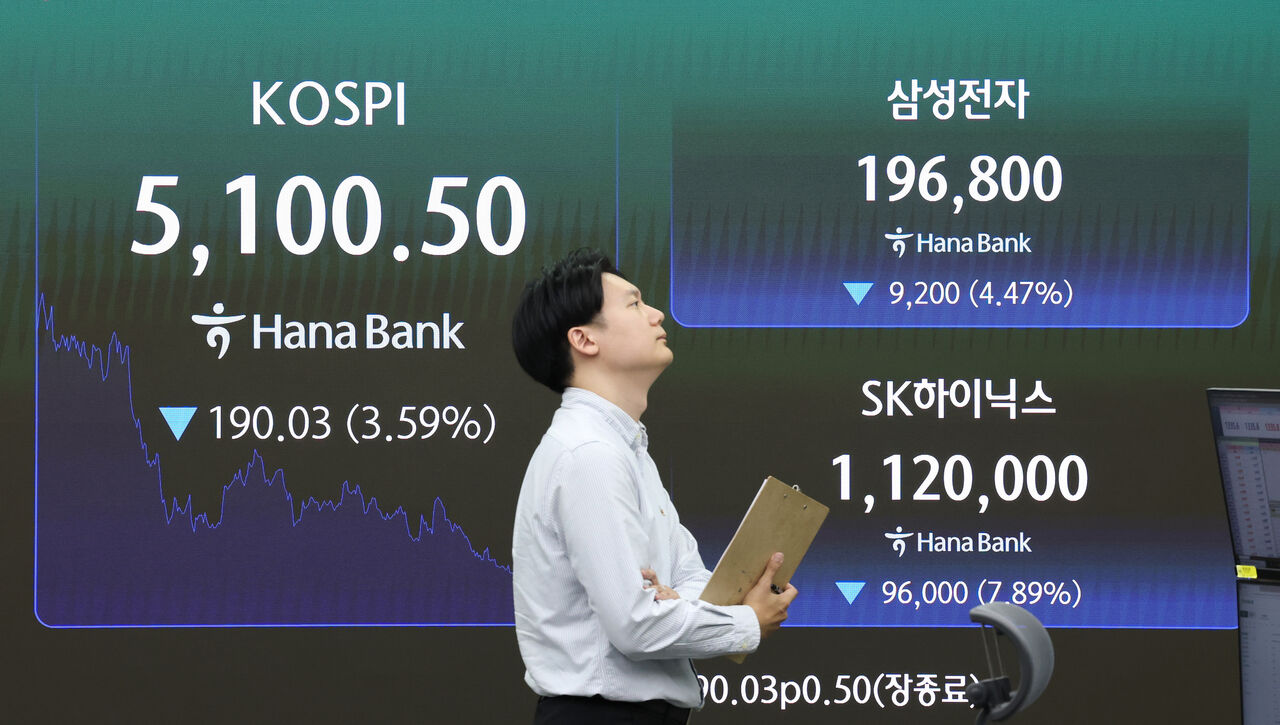
South Korean stocks fell sharply on combined selling by foreign investors and institutions. Semiconductor heavyweights slid, pushing the KOSPI down to the 5,100 level, while the KOSDAQ fell nearly 5 percent.
On the 16th, the KOSPI ended at 5,100.50, down 190.03 points, or 3.59 percent, from the previous session. The index opened at 5,305.40, up 14.87 points, or 0.28 percent, but quickly turned lower and gradually widened losses.
By investor type, foreigners led the decline with net selling of 1.3769 trillion won. Institutions also sold a net 459.7 billion won. Retail investors absorbed supply with net buying of 1.3482 trillion won.
Among the top market-cap stocks, weakness in semiconductor shares stood out.
Samsung Electronics closed down 4.47 percent at 196,800 won. SK Hynix fell 7.89 percent to 1.12 million won.
Elsewhere, SK Square sank 9.71 percent and Samsung Electro-Mechanics fell 8.19 percent. LG Energy Solution lost 1.85 percent and Hyundai Motor fell 1.48 percent.
In contrast, Samsung Biologics ended up 0.85 percent at 1.423 million won. KB Financial rose 1.64 percent and Samsung Life climbed 0.60 percent.
Losses were larger on the KOSDAQ market.
The KOSDAQ ended at 665.65, down 34.01 points, or 4.86 percent, from the previous session. It extended declines from early trade and widened losses in the afternoon.
In the Seoul foreign exchange market, the won was at 1,334.80 per dollar, down 3.20 won from the previous session.
South Korean stocks weakened as profit-taking pressure increased during the recent rebound and foreign demand deteriorated at the same time. Selling was concentrated in semiconductor heavyweights such as Samsung Electronics and SK Hynix, widening the KOSPI's decline.
Han Ji-young (한지영), an analyst at Kiwoom Securities, forecast that local stocks this week could be affected by external events including the minutes of the U.S. Federal Open Market Committee meeting, remarks by key Federal Reserve officials and Nvidia results.
Han said changes in foreign demand linked to these events could determine the direction of local stocks. She also expected a wait-and-see mood to persist for the time being as investors seek to confirm outcomes from key schedules.
 Sangyeop Oh
yub@d-today.co.kr