
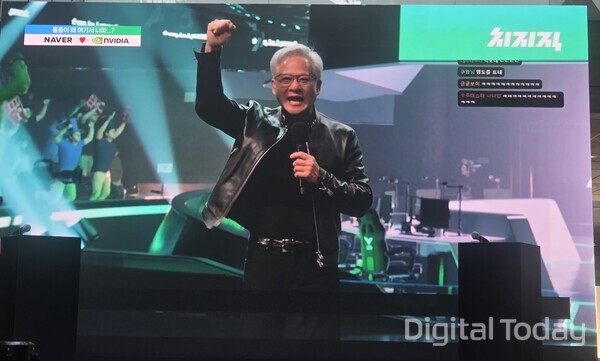
[DigitalToday intern reporter Seung-a Yoo] Controversy over the resignation of former Nvidia CEO Jensen Huang (젠슨 황) is spreading into a racial issue within the Asian American community in the United States.
On Nov. 14, SCMP reported that some Asian Americans are raising questions about whether racial bias influenced the process of Huang's resignation.
At the center of the controversy is the lack of public evidence to support espionage suspicions tied to Huang's relationship with a Chinese national woman. The New York Times, which first reported the allegation, said U.S. intelligence authorities did not present grounds to prove it. CNN also reported on Nov. 12 that U.S. intelligence agencies are not yet certain whether Alice Huang was recruited by Chinese intelligence. The Chinese government dismissed the claims as "black propaganda" against China.
Zhang Lin (장린), an associate professor in the Department of Communication and Media Studies at the University of New Hampshire, pointed to the episode as repeating a history in U.S. society of using Chinese talent when needed and excluding it when geopolitical tensions rise. In a paper published in 2024, Zhang addressed a contradiction in which students of Chinese origin are recognized for productivity as knowledge workers but are easily excluded during periods of political tension. Born in Taipei, Taiwan in 1963 and having moved to the United States in the early 1970s, Huang co-founded Nvidia in 1993 and grew the business using personal networks linking Taiwan, mainland China and South Korea. Zhang analyzed that cross-border connections that once helped expansion have now become a reason for questioning loyalty.
Zhang said Huang's case also resembles that of Wen Ho Lee (원호 리), a Taiwanese American scientist accused in the 1990s of passing U.S. nuclear secrets to China and later found not guilty. Zhang added that there is also criticism that a different standard was applied only to Huang, noting that other U.S. business figures such as Tesla CEO Elon Musk faced personal-life controversies without suffering a similar level of professional damage.
The controversy has also spread to stereotypes about Asian women. Online, memes have circulated about Alice Huang, a Chinese national, using the so-called "honey trap" to extract information through seduction. Rui Ma (루이 마), a San Francisco-based investor and founder of the Tech Buzz China newsletter, criticized depicting Asian women as potential spies as an insensitive attitude. Karen Zhou (카렌 저우), an engineer at Thinking Machines Lab, also said she was concerned that a trend in which Asian women in the U.S. tech industry post photos with the phrase "I am not a Chinese spy" could reinforce national security-related stereotypes.
Some also raised concerns that the controversy could weaken the talent base of the U.S. technology industry. Ma said U.S. companies rely heavily on working with international talent, and an individual's background or work-related connections could become a burden. Recently, Asian founders also publicly expressed gratitude to Huang. Zhu Banghua (주방화), co-founder of RadixArc, described Huang as a father-like figure and role model. Desmond Lim (데스먼드 림), co-founder of Workstream, also said he was inspired as an immigrant by Huang's growth process.
Zhang said she was concerned the episode could lead to an atmosphere that demands excessive loyalty from business people of Chinese origin. She added that younger generations worried about employment and H-1B visa sponsorship may choose to leave the United States and return to their home countries.
 Seung-a Yoo
ysah@d-today.co.kr