
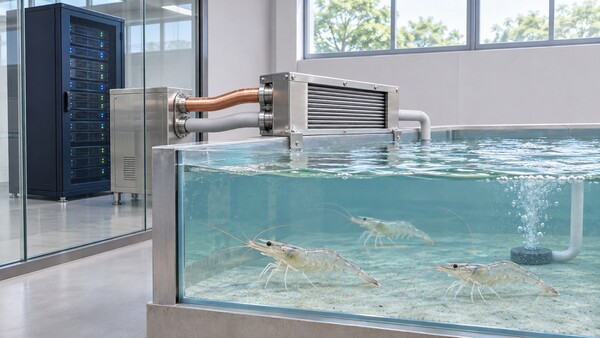
Japan's telecommunications company NTT Docomo Business has launched a demonstration project to raise edible shrimp using waste heat generated by data centres. It aims to reuse heat discarded during server cooling for fisheries to cut energy costs and reduce the environmental burden of data centres.
According to Japanese outlet ITmedia, NTT Docomo Business, IMT Engineering, Hibiya Engineering and NTT Green&Food are pursuing a project to build a land-based aquaculture system using data centre waste heat.
The project was selected for the Tokyo Metropolitan Government's programme to promote the use of unused heat by startups. It will use an NTT Docomo Business data centre near Tokyo as the test site and run through March 2028.
The core is technology that keeps shrimp-rearing water at a constant temperature using waste heat recovered from data centre cooling equipment.
This year, the companies will measure the waste heat's temperature and heat output and verify a heat recovery method suitable for aquaculture. In fiscal 2027, they plan to raise vannamei shrimp using the recovered heat and assess the water temperature maintenance effect and the level of energy savings.
They will also check the impact on data centre operations. They plan to develop a design method to calculate an appropriate farm size based on each facility's cooling method and waste heat conditions.
The participating companies will split roles. NTT Docomo Business will provide the data centre and demonstration environment, and IMT Engineering will handle aquaculture system design and rearing.
Hibiya Engineering will build waste heat recovery and supply facilities, and NTT Green&Food will monitor the rearing environment and evaluate the effects on cutting production costs and business feasibility.
Vannamei shrimp, the target species, is an edible shrimp widely farmed in Southeast Asia and elsewhere. When fully grown, it reaches a body length of 15 to 20 cm. It was selected for the trial because it can be raised in 16 to 18 weeks using land-based aquaculture technology.
Behind the project are different energy problems for data centres and land-based aquaculture. As AI spreads, data centres' power consumption and waste heat output are rising, but waste heat has limited uses because its temperature is low. Land-based aquaculture, by contrast, requires significant energy to heat rearing water.
The four companies plan to verify the impact on cutting production costs through the trial and develop a business model that can be applied to other data centres. They will consider selling the shrimp once they grow to a shippable condition, but no specific schedule or sales channels have been decided.
 Jae-won Choi
ittt_0801@d-today.co.kr