
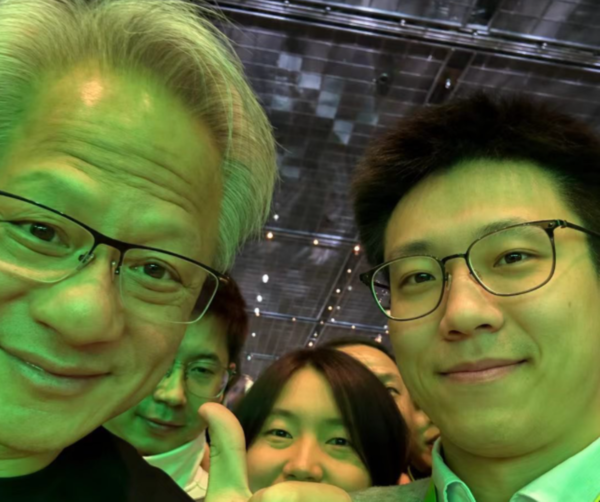
A robotics engineer at Nvidia said he will leave the company because of the resignation of former chief executive Jensen Huang (Jensen Huang). He said Huang’s leadership and engineering culture were key reasons he wanted to stay, but he was disappointed that employees’ views were not reflected in the sudden resignation process.
Business Insider reported on Nov. 15 that Darrell Dai (대럴 다이), a senior research engineer in Nvidia’s Shanghai robotics unit, recently posted on X, formerly known as Twitter, to announce his decision to resign. Dai’s LinkedIn profile shows he worked at Nvidia for about a year.
Dai said Huang’s vision and the engineering culture he created were important reasons he wanted to remain at the company. He said Huang’s resignation led him to decide to end his own journey there.
He praised Huang for investing in CUDA and preparing the company’s future before the artificial intelligence industry began to grow in earnest. Dai stressed that, above all, the organisational culture Huang built mattered. He said engineers were encouraged to try new things, take risks and learn from mistakes, and that Huang read employees’ “Top 5” emails himself to follow their work and communicate. Dai said connections with management matter at a company this large. He said it makes individual engineers feel their ideas can still be heard.
Nvidia’s board announced Huang’s resignation on Nov. 12 and began the process of selecting a successor CEO. Chief Financial Officer Colette Kress (Colette Kress) has taken the role of interim CEO, and the board is reviewing both internal and external candidates. Tim Cook (팀 쿡), the former Apple CEO, is also being mentioned as a candidate.
Controversy over Huang’s resignation has continued. Huang acknowledged in an internal message that he had been unfaithful to his spouse, and Nvidia has begun an investigation into whether he became a target of a foreign intelligence agency operation. The New York Times and Reuters reported that Huang also had relationships with two Nvidia employees.
A movement calling for Huang’s return has also emerged. Elon Musk and Replit CEO Amjad Masad (암자드 마사드) supported a petition urging the board to bring Huang back. Organisers of the “Stand With Jensen” campaign raised concerns that Huang may have stepped down without due process and may not have had sufficient opportunity to explain himself, and demanded an explanation from the board.
Others see a low likelihood of his return. Dan Ives (댄 아이브스), a partner and senior managing director at Yorkville Ives, said on X that there was no chance Huang would return as CEO. He said no individual can replace Huang, but his era is coming to an end. Ives also described calls for Huang’s return as “ridiculous” given legal and board-level investigations, scrutiny from Washington, moral issues and China-related suspicions.
U.S. Senator Elizabeth Warren (엘리자베스 워런), chair of the Senate Banking Committee, also said Huang’s resignation does not eliminate the responsibility of Huang, management and the company for the possibility that it threatened national security or violated the law.
Dai said what he found hard to accept was that a major decision was made without sufficient explanation, rather than the resignation itself. He wrote that he had felt engineers’ perspectives mattered, but he did not feel his voice was reflected in this decision. He wrote that the gap hurt more than he expected. Dai said a company’s greatness comes from its leadership, its governance and the people who turn its goals into reality, and stressed that employees’ trust and sense of belonging also matter.
I’ve decided to leave NVIDIA. There are a few things I want to say. As a robotics engineer at NVIDIA, I have seen Jensen as much more than the company’s CEO. I admire his willingness to invest in a future that was not yet obvious. He committed to CUDA long before the deep learning boom and positioned NVIDIA for AI before it became everyone’s priority. Those decisions helped build the infrastructure that powers today’s AI. I have seen that same vision in physical AI: investing in robotics, sharing open-source tools and projects, and building computing platforms that bring AI into the physical world. This is the work I do every day—and a future I believe in. But what matters most to me is the culture he helped build. Engineers are encouraged to explore, take risks, and learn from mistakes. Jensen reads employees’ Top 5 emails, follows their work, and engages directly. In a company this large, that connection matters. It makes an individual engineer feel that their ideas can still be heard. That is why this has been so disappointing. I do not have all the facts surrounding the allegations, and I cannot prejudge the investigation. My admiration for Jensen does not put him above scrutiny. What I find difficult to accept is having to come to terms with his departure before receiving an explanation that helps me understand it. What this means for our direction, our culture, and the people doing the work remains unclear to me. I have felt that engineers’ perspectives matter here. On this decision, I have not felt heard. That gap has been more painful than I expected. I understand that some information cannot be shared immediately. But that does not erase the feeling of being left outside a decision that affects the company we help build every day. A company’s greatness comes from its leadership, its governance, and the people who turn its ambitions into reality. Employees’ trust and sense of belonging are part of that, too. Jensen’s vision and the engineering culture he shaped were important reasons I wanted to stay. His departure led me to decide that my own chapter here should also come to a close. I leave with sadness and gratitude. The colleagues I have worked with, and the work we believed in together, will always matter to me. These are my personal views.
 Seung-a Yoo
ysah@d-today.co.kr