
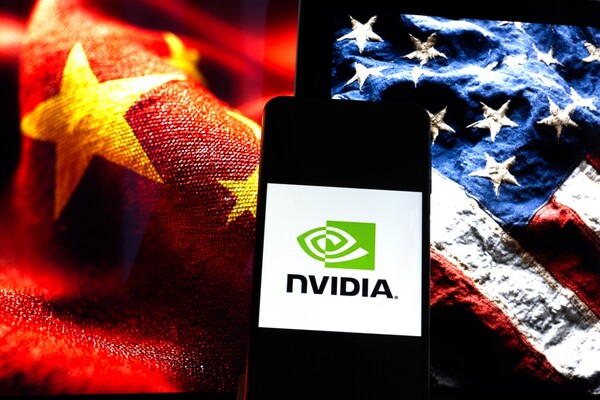
[DigitalToday reporter Jinju Hong (홍진주)] Many AI projects being pursued in China worth more than $3.2 billion appear to have been designed on the assumption of using Nvidia chips that are subject to U.S. export controls.
On Nov. 13 local time, blockchain media outlet Decrypt reported that Reuters analysed more than 150 procurement notices, investment plans and company records. It confirmed cases in projects totalling 23 billion yuan that specified Nvidia H100, H200 and H800 chips.
The $3.2 billion figure is not spending on chip purchases, but total project costs including buildings, power and other infrastructure. Related documents do not show whether all processors were actually secured or whether there were violations of export rules. Reuters made this clear, noting that operating facilities and investments at the proposal stage do not imply the same level of chip access.
The still-heavy presence of Nvidia in the design of AI data centres in China also emerged in individual projects. A computing centre plan in Fujian province is worth 6.2 billion yuan and its official investment documents specify H100 servers, but it is still seeking financing partners. In Shaanxi province, a state-owned engineering group won a contract related to a 3 billion yuan centre in which H100 and H200 chips were mentioned. A 2.26 billion yuan project in Jilin province proposed using Nvidia equipment together with Chinese-made processors.
In Inner Mongolia, a development plan specifying 625 H200 servers was also confirmed. Authorities in Wuxi said a computing cluster based on H800 began operations in March 2025. Operating cases and new investment plans do not, however, prove actual chip procurement.
The trend shows China’s AI industry is weighing practical options. Nvidia chips can process thousands of computations at once, which is advantageous for high-performance AI training. Nvidia’s software ecosystem is also widely used, so switching to rival systems could require software modifications and additional engineering costs.
The United States has limited sales of advanced AI chips to China since 2022 on national security grounds. In January 2026, the U.S. Commerce Department moved H200 export applications to case-by-case review, and sales still require approval. Shipments of the H100 face stricter restrictions. Chinese developers therefore have to choose whether to design facilities around familiar Nvidia equipment or shift to alternative chips while accepting the burden of software changes.
Nvidia’s remaining influence is also reflected in market share. An IDC report cited by Reuters said Nvidia’s share of AI accelerator shipments in China in the first half of 2026 was 34 percent, ahead of Huawei’s 28 percent. The figure reflects the overall AI accelerator market in China and does not mean actual shipments of models subject to export controls.
Chinese companies are also continuing efforts to find alternatives. Chinese AI developer Z.ai, formerly Zhipu AI, has already released an image-generation model trained using only Huawei chips. It is a case showing that competitive systems can be built without U.S.-made hardware. Even so, the project records show that Nvidia remains deeply embedded across China’s AI infrastructure planning.
Against this backdrop, the U.S. government is expected to face greater pressure over how it enforces export controls. Congress is examining how effectively advanced-chip restrictions are being enforced in practice. As Nvidia chips keep appearing in China’s new AI infrastructure plans, scrutiny over the effectiveness of the rules and their on-the-ground enforcement could intensify.
 Jinju Hong
hongjj@d-today.co.kr