
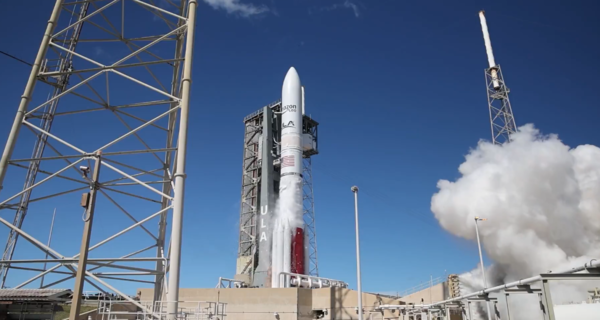
[DigitalToday intern reporter Seung-a Yoo] United Launch Alliance's (ULA) Vulcan rocket suffered an anomaly during launch and failed to put 40 of Amazon's low-Earth orbit satellites into orbit. It was the first time a ULA launch vehicle mission has failed since the company was established in 2006.
On Nov. 15 (local time), foreign media including The Verge reported that ULA's Vulcan rocket was launched from Space Launch Complex 41 (SLC-41) at Cape Canaveral Space Force Station in Florida. An anomaly occurred about 10 minutes into the flight, preventing the Amazon satellites from reaching orbit.
The launch was a mission to deploy satellites for Amazon's low-Earth orbit satellite internet project, Amazon Leo. Amazon Leo is a satellite internet service competing with SpaceX's Starlink and is expanding launch operations to secure the required number of satellites. But only some of the satellites needed for the overall project have been placed in orbit so far.
The mission was also the first of a total of 38 launches Amazon ordered from ULA. Amazon's plan to deploy large numbers of satellites using the Vulcan rocket has inevitably been disrupted. Amazon had planned to carry out the second mission within weeks after this launch.
ULA said on X, formerly Twitter, that based on data received by the launch director, the Vulcan rocket suffered an anomaly about 10 minutes into the flight and failed to deliver the Amazon mission to orbit. It added that the specific cause has not yet been confirmed.
ULA said that because the anomaly had just occurred, there is not yet enough specific data to determine the cause. It said it would work with Amazon and related organisations to identify the cause and develop the necessary corrective actions. It also said it would disclose the investigation process transparently and resume flight as quickly as possible.
Amazon maintained its trust in ULA despite the failure. In a post on X, Amazon said every launch carries risk, and the risk is even greater on a first mission such as LV-01. It added that ULA is a trusted partner and said it believes ULA will learn from the mission and carry out Vulcan's long-term operational plan.
The failure has left ULA with the task of restoring confidence in Vulcan's commercial launch reliability. Amazon also faces the need to review its satellite deployment schedule and follow-on launch plans. Attention is expected to focus on the results of ULA's investigation, when Vulcan returns to flight, and any resulting adjustments to Amazon's satellite deployment schedule.
Based on data received by our Launch Director, we confirm that the Vulcan vehicle launched from Space Launch Complex 41 suffered an anomaly 10 minutes into the flight and failed to deliver the Amazon mission to orbit. Every flight generates data, and every flight teaches us something. Since the anomaly just occurred, we don’t have any specific data yet to understand what occurred today. ULA exists to provide assured access to space for our nation and for the customers who depend on us. That purpose is why we take on some of the hardest missions in spaceflight, and why we hold ourselves to the standard of mission success. Today, we did not meet that standard. We will work closely with our customer and other appropriate organizations to find the cause, determine the appropriate corrective action, and return to flight as quickly as possible. ULA is committed to full transparency with our customers, and they will have visibility into the investigation process, which utilizes rigorous methodology and corrective action. We will provide further updates when new information becomes available.
 Seung-a Yoo
ysah@d-today.co.kr