
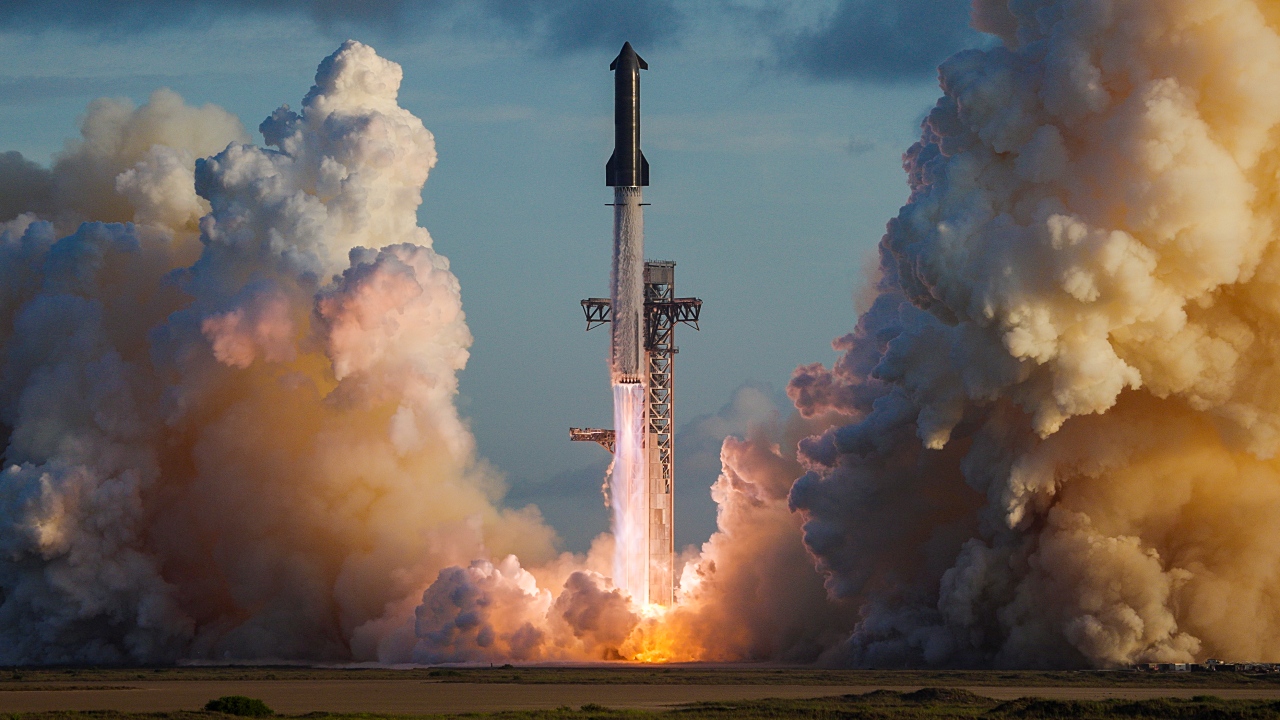
[DigitalToday reporter Jinju Hong] SpaceX’s next-generation heavy-lift rocket Starship is repeating partial gains and failures in a string of test flights. It has made technical progress, including successfully deploying Starlink satellites, but engine failures, vehicle explosions and unsuccessful booster recoveries have continued. That has led to an assessment that the goal of a fully reusable rocket remains a long way off.
On Nov. 11 local time, IT outlet Engadget reported that Starship successfully reached orbit for the first time in September and deployed 26 Starlink satellites. But it failed to complete its planned mission of about 10 hours, including six orbits of Earth, due to an engine failure. The mission was halted soon after orbital insertion, revealing both achievements and limits.
Starship’s development has shown a pattern of success and failure alternating. SpaceX pursues an approach of rapidly repeating failures, securing data and improving its design. Of 14 launches so far, the number that could be classified as failures varies from 4 to 11 depending on the criteria. It is clear, however, that there have been many cases in which key goals set for individual test flights were not achieved.
The first test flight in April 2023 ended in an explosion about 65 miles short of its atmospheric re-entry target. At the time, SpaceX CEO Elon Musk (일론 머스크) said on X, formerly Twitter, “Congratulations on an exciting Starship test launch,” and added, “Learned a lot for the next test launch.”
The second flight succeeded in separating the first and second stages, but both the booster and the spacecraft were later destroyed. The third test flight reached an altitude of up to 145 miles and carried out several objectives, but the vehicle broke apart during return. In the next 2 tests, it maintained relatively stable flights and also achieved the capture of the Super Heavy booster with the launch tower’s mechanical arms.
But the stability did not last long. In the sixth test, it gave up capturing the booster using mechanical arms, and the Super Heavy booster fell into the Gulf of Mexico. In the seventh test, Starship exploded over the Bahamas about 8 minutes after liftoff. The U.S. Federal Aviation Administration and the Turks and Caicos government began investigations.
In the eighth test, the vehicle also exploded in space, causing disruptions to flight operations in the Florida area. The ninth test showed some improvements, but the plan to deploy 8 dummy satellites was also canceled as the vehicle lost control.
It later delivered meaningful results as well. In an August 2025 test, Starship released Starlink satellites as payload for the first time. In the 11th test in October that year, it achieved key goals by succeeding in both launch and landing. But in the 12th test, the upgraded Starship V3 fell into the Gulf of Mexico due to an engine failure and became the subject of another investigation.
In the 13th test in July 2026, it succeeded in deploying 20 high-power Starlink satellites but failed to recover the first-stage booster. Its satellite deployment capability advanced, but it has still not achieved the core goal of recovering and reusing the entire rocket.
SpaceX is accelerating Starship development because its uses are broad. Starship is expected to be used, on the premise of full reusability, for transport to Mars, the U.S. space agency NASA’s Artemis lunar exploration missions, and construction of mega-constellations. Its payload capacity is about 5 times that of the Falcon 9. Partial test successes can be assessed as technical progress given its ability to transport large cargo in a single launch, but it must prove stability and reusability for actual missions.
In particular, the schedule for developing the lunar lander is adding pressure. NASA said earlier this year that the Starship-based Artemis lunar lander program has been delayed by at least 2 years from the plan made when it was selected as the contractor in 2021. The United States is aiming to return to the moon in 2028, and for that it must meet the schedule for Artemis III planned for the summer of 2027. China is also pushing for a crewed lunar landing by the late 2020s, increasing the schedule pressure on the United States.
SpaceX will try to recover both Starship and the Super Heavy booster in the next test flight scheduled for Nov. 13. Musk said during the third-quarter earnings call that the attempt would be “the first case of completely recovering an orbital launch vehicle.” He also expressed confidence about the chance of success, saying it was “more likely to succeed.”
The test flights have produced results such as satellite deployments and launch-tower catches, but engine failures and vehicle destruction are still recurring. Whether it can recover both the rocket and the booster in this test is expected to be an important turning point for Starship’s full reusability goal and the lunar lander development schedule.
 Jinju Hong
hongjj@d-today.co.kr