
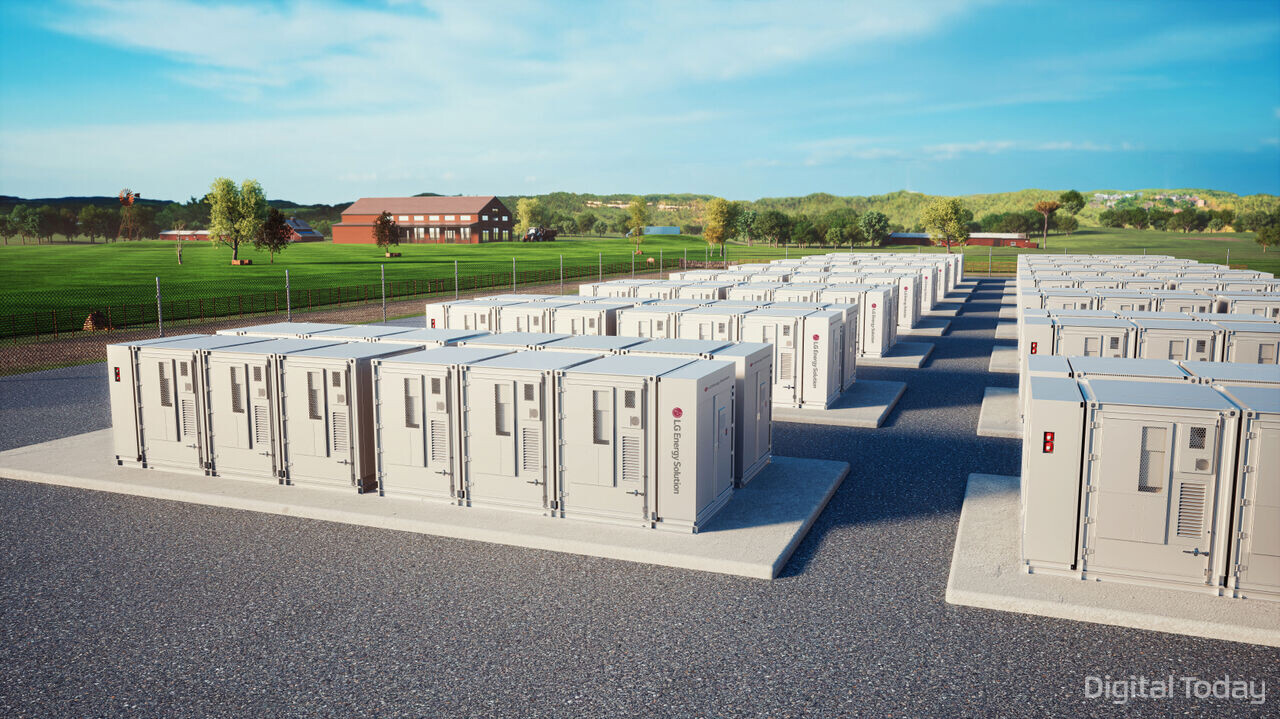
South Korea’s three battery makers, which lost ground in the electric vehicle (EV) battery market to Chinese rivals, are counterattacking with energy storage systems (ESS). While Chinese companies expand their EV market share, Korean companies are switching EV lines to focus on ESS in North America and signing long-term contracts to speed up early market capture. They are also emphasising high value-added, high-output products for data centres and deliveries in complete-product units, in what is seen as an effort to secure a market that will not be easily surrendered even if Chinese competitors later push prices down.
According to SNE Research, the combined share of 7 Chinese companies in the global EV battery market rose to 73.0 percent in January to September this year. The combined share of South Korea’s three companies fell to 12.6 percent.
The three Korean battery makers instead found a way forward in ESS. They secured ESS demand boosted by data centre construction in North America through contracts spanning several years. LG Energy Solution’s ESS order backlog stood at 160 GWh at the end of the third quarter, and most volumes are fixed through 2028 based on its currently planned production capacity. Samsung SDI also secured volumes to run its Ulsan line at full capacity through 2028 with StarPlus Energy (SPE) in the United States. SK On’s lithium iron phosphate (LFP) cell supply contract for ESS with U.S. company NeoVolta Power signed in September runs through 2031.
An additional advantage has been that Chinese-made products cannot enter the ESS field. The U.S. Internal Revenue Service (IRS) in February set standards that restrict supply chains supported by prohibited foreign entities (PFE) from benefits including ESS investment tax credits. The U.S. government in August also tightened supply chain standards for power grid equipment through an executive order.
Among areas where ESS products are installed, buyers such as data centres that value output and stability are unlikely to easily switch suppliers even if Chinese companies cut prices. With competition not decided by price alone unlike EV batteries, the outlook for the three Korean companies’ ESS business is seen as relatively bright.
Backup power for data centres is a representative case. Data centres must keep servers running even if power is cut, so they use battery backup units (BBU) that deliver high output in a short time. LG Energy Solution plans to start mass production in the second quarter next year of an LFP product for BBUs based on a tabless 2170 cylindrical battery. According to Eugene Investment & Securities, Samsung SDI’s cylindrical battery utilisation rate is estimated at more than 80 percent due to BBU demand, and margins for cylindrical and prismatic batteries remain higher than for pouch batteries.
Supplying complete products rather than only cells is also a major competitive edge. Samsung SDI shipped cells from its SPE plant in mid-October and will deliver its ESS finished product, SBB, from December. LG Energy Solution has pack plants in Michigan, Ontario, Illinois and Ohio and a system integration base in Arizona, and is increasing the share of data centre and system integration (SI) projects.
North American ESS production capacity will be expanded from more than 50 GWh by the end of this year to around 70 GWh by the end of next year. It signed its first contract to directly supply ESS to big tech data centres, and was also selected as Nvidia’s only ESS partner among Korean battery makers.
◆Building a high value-added defence line with high-output and finished ESS products
Choices of chemical materials are also broad. Samsung SDI is increasing shipments of ESS based on nickel-cobalt-aluminium (NCA), a ternary chemistry, while expanding its supply range to LFP. Its U.S. joint venture Synergy Cells, which acquired all of GM’s stake, plans to mass-produce next-generation LFP for ESS from the second half of 2028. LG Energy Solution is producing mid-nickel and LFP together, and plans to make ESS samples of sodium-ion batteries within this year and test them with North American customers next year.
Profitability has entered an improving trend. LG Energy Solution’s third-quarter ESS shipments rose 60 percent from the previous quarter, and the company projected that fourth-quarter ESS shipments would rise a further 40 percent. It plans to boost profitability by reducing fixed-cost burdens through production stabilisation, diversifying material procurement, cutting logistics costs and increasing the share of data centre and SI projects.
Daishin Securities forecast that the ESS division is still in the red excluding North American manufacturing production credits (AMPC), but will swing to profit as initial ramp-up of new lines is completed next year. Even considering that one-off factors such as compensation were included in third-quarter profit, ESS profitability is expected to gradually improve from next year as rising shipments align with stabilising costs.
An industry official said, "In the battery industry, what matters in the end is a clear demand base (customers) that will buy products steadily," and added, "It is positive for long-term profitability improvement that K-batteries have secured high value-added customers in North American data centres and big tech."
 Daegeon Seok
d2dg@d-today.co.kr