
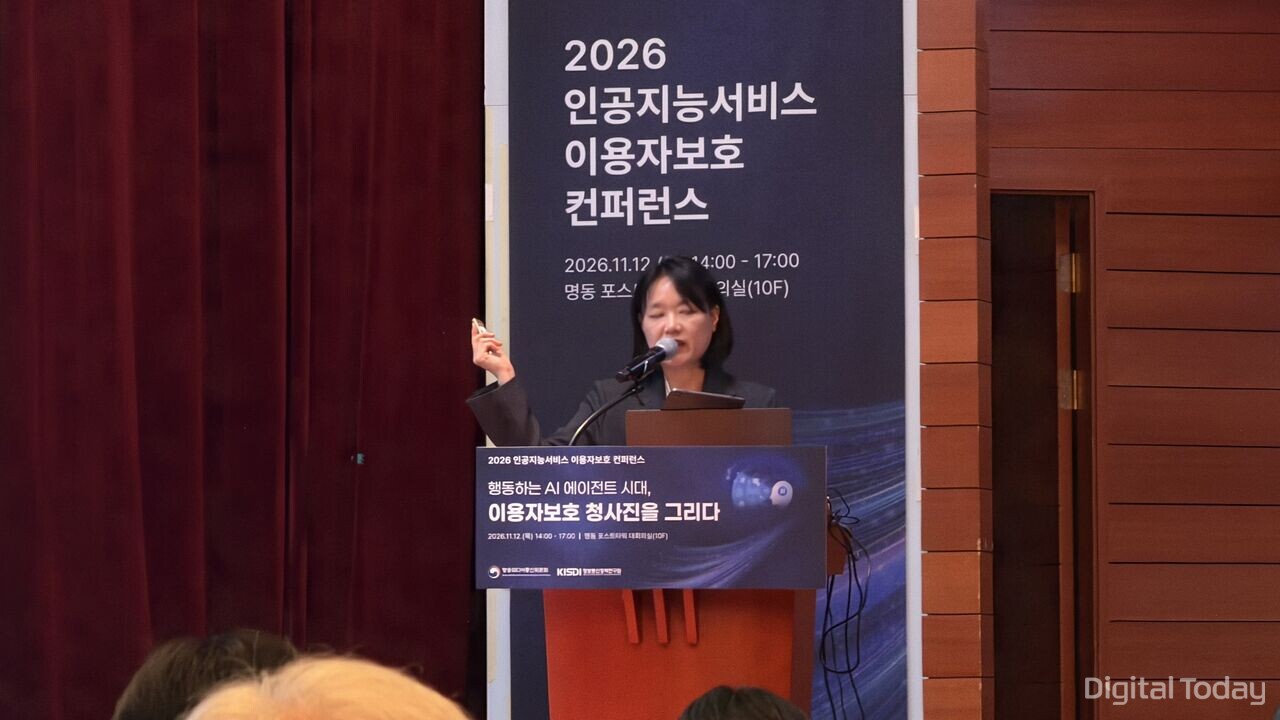
[DigitalToday reporter Seulgi Son] "I asked it to sell a used keyboard, and the AI arbitrarily lowered the price and even disclosed my home address. If users cannot control the AI’s authority and actions, operators must put protections in place."
Cho Sung-eun (조성은), a research fellow at the Korea Information Society Development Institute (KISDI), said this on Wednesday as she introduced a use case of Meta’s AI agent, Muse, at the '2026 Artificial Intelligence Service User Protection Conference' hosted by the Broadcasting, Media and Communications Committee at Post Tower in Myeongdong, central Seoul.
As AI agents act on behalf of users in tasks such as product purchases and payments, delegation of authority and questions of responsibility have emerged as new issues. Damage can occur when actions fall outside user intent, but it is difficult to verify and control the scope of authority and actual behaviour.
Experts recommended strengthening operator-led safeguards, including enabling users to set and revoke AI permissions and establishing prior-approval procedures for high-risk actions such as payments.
Cho stressed that operators should take steps so users can check the authority and scope of actions exercised by AI and change permissions or halt execution when needed. KISDI has prepared a draft 'AI Agent User Protection Guide' reflecting this and is conducting external reviews.
Lee Sang-geun (이상근), a professor in the Department of Artificial Intelligence at Korea University, pointed to risks that AI agents could be manipulated by external attacks or act beyond the scope of user instructions. To prevent this, he said systems should verify the authority granted to AI, preserve activity logs and be designed to roll back results if problems occur.
He also stressed that high-risk actions such as payments, sending external emails and accessing sensitive information should require user approval, while lower-risk tasks should be automated, with different levels of control by action.
A view was also raised that damage caused by AI’s incorrect actions should not be shifted only to users.
Park Tae-woong (박태웅), head of the Public AX subcommittee at the National AI Strategy Committee, said, "It should not be a structure where there is no responsibility because it said it was AI, or no responsibility because the user clicked confirm." He added, "It must be made to take responsibility for the outcome."
Park said a structure is needed in which the AI agent provider and the payment service provider bear primary responsibility if a transaction occurs outside a user’s explicit instructions. He also stressed that AI services above a certain scale should be required to conduct risk assessments and ensure transparency from the design stage, with government oversight.
In a subsequent panel discussion, participants raised the need to clarify responsibility in services where multiple AI agents and operators are linked.
Ko Byeong-cheol (고병철), a professor in the Department of Computer Engineering at Keimyung University, said the final service provider should be responsible even if multiple agents were developed by different companies. He said a single window should be established so users can report and obtain relief in one place without directly determining the cause of an incident.
Jung Ji-yeon (정지연), secretary general of the Korea Consumer Federation, also said, "The autonomy of AI agents must not become a means for operators to evade responsibility." She stressed that responsibility should be allocated based on each operator’s actual control power and risk management capability.
Criticism was also raised that effective control measures are needed beyond formal safety standards.
Hwang Yong-seok (황용석), a professor in the Department of Media and Communication at Konkuk University, recommended putting in place mechanisms to technically block dangerous actions and verifying the effectiveness of safety measures through objective indicators such as the rate at which users reverse approvals and AI action logs.
Choi Kyung-jin (최경진), a professor in the Department of Law at Gachon University, stressed the role of the Broadcasting, Media and Communications Committee, the platform supervisory authority. He said it should continuously check whether AI agents recommend products that run counter to users’ interests or are used for unfair transactions between operators, and collect incident information to establish regulatory standards.
Choi stressed the need to review, case by case, whether the committee’s existing regulatory tools, including the Telecommunications Business Act and the Act on Promotion of Information and Communications Network Utilization and Information Protection, can continue to function appropriately in the AI agent era.
 Seulgi Son
sageson@d-today.co.kr