
Global industrial software company PTC has flagged plans for aggressive investment in the South Korean market. It will first open a customer experience centre at its office in the Parnas Tower in Samseong-dong, Seoul, in April or May next year. The aim is to offer product demos in South Korea that were previously available only at headquarters, and to enable customers with factories in Southeast Asia to visit.
Earlier, PTC Korea opened a Busan office in October to step up its push into the Yeongnam region. It also formed an enablement team early this year to support partner and university education.
The moves reflect the growing potential of the South Korean market. PTC is particularly focused on South Korea's aerospace and defence markets.
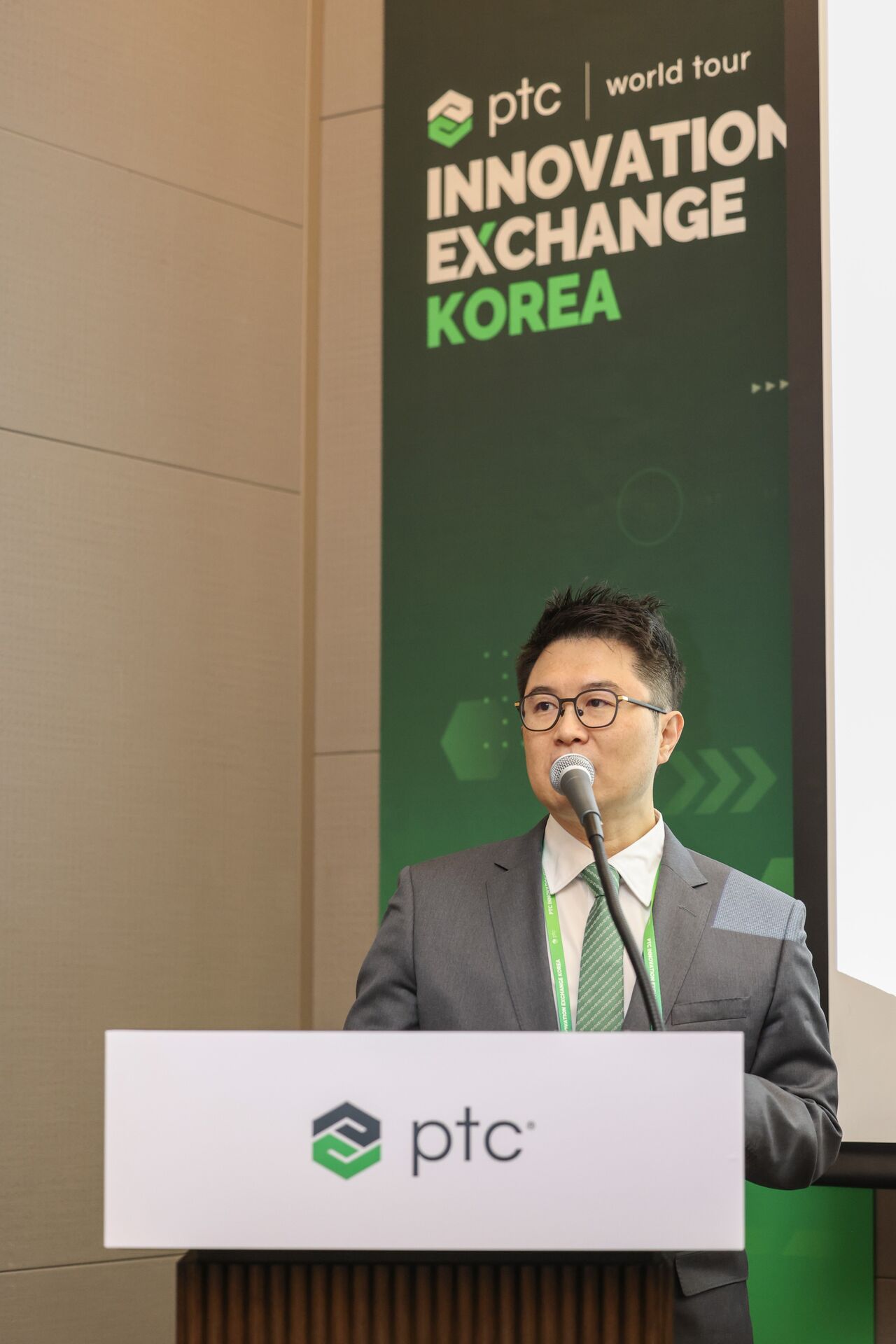
Do-gyun Kim (김도균), head of PTC Korea, picked aerospace and defence as the top growth market and signalled a major push at the 'PTC Innovation Exchange 2026' event held at the Grand InterContinental Seoul Parnas on Wednesday.
Policy changes in various countries underpin PTC's focus on the defence market. Alex Daily (알렉스 데일리), head of national security at PTC, said the U.S. government mandated the use of digital engineering software in weapons development and procurement projects about 3 years ago.
The key point is that CAD, PLM and model-based systems engineering tools must be used from the early stages of a project throughout its lifecycle. "Digital engineering is no longer nice to have, it has become a must," he said. He added that about 6 countries, including Australia, have created similar rules in Europe and the Asia-Pacific region.
Market conditions are also positive. As the situation in Europe, the Middle East and the Asia-Pacific becomes more urgent, defence spending by countries has risen sharply, and defence companies' order backlogs have been increasing for years on the back of that trend.
Daily said executives' concern is how to turn record order backlogs into revenue and profit. He said it inevitably leads to integrating engineering and manufacturing to increase output, and he saw strong potential in unmanned systems, missile defence, space and shipbuilding. PTC counts the U.S. Army and Navy, the National Aeronautics and Space Administration, Raytheon and Lockheed Martin as customers.
PTC is stressing openness in its push into the defence market. The company said it supports sharing product data with ERP and manufacturing execution systems in line with the Modular Open Systems Approach demanded by the defence industry. Daily said he expects the South Korean government could adopt digital engineering as a way to speed up the development of new capabilities such as drones, electronic warfare systems and radar.
PTC Korea has focused over the past 33 years on the automotive, electronics and battery, and heavy industry sectors. Kim said there are still gaps in its domestic defence and aerospace business but it will continue to expand. He said it will also pursue expansion in existing markets such as autos and shipbuilding while focusing on the MedTech market in addition to aerospace and defence.
On the product side, it stands out that it is putting AI at the forefront and rapidly expanding services aimed at manufacturers. PTC has specialised in CAD, product lifecycle management and application lifecycle management. It is also accelerating an expansion of its Service Lifecycle Management business.
The strategy is to complete an "Intelligent Product Lifecycle" portfolio that connects the entire product lifecycle from design to service.
Kim said after-sales service is an area that domestic manufacturers have not been able to focus on. He said that with expensive rocket parts, for example, it is not known when and where problems will occur. He said companies must be able to predict when and how many parts need to be supplied.
In SLM, people are also an important pillar. Kim said when complex advanced products break down, instructions must be clear on how on-site staff should fix them. He said many customers manage this through manuals or Excel, but they can provide more effective support using AI. He added that it will increase specialised staff to secure SLM customers and will also cooperate with global R&D organisations.
The AI strategy is being pursued through 3 main routes. Joseph Jun (조셉 준), head of PTC's service solutions business and head of AI innovation, said it is embedding AI in existing products and equipping all products with MCP servers so customers can operate PTC products with their own agents and models. He said it also provides an AI-based, cloud-native enterprise asset intelligence platform linking multiple products called PTC Orbit.
He then divided AI's role into three stages - advice, assistance and automation - and said it will evolve from receiving suggestions on how to reduce component weight to creating 3 alternatives and running simulations, and then to entrusting the entire design and testing process while humans only approve.
 Chi-gyu Hwang
delight@d-today.co.kr