
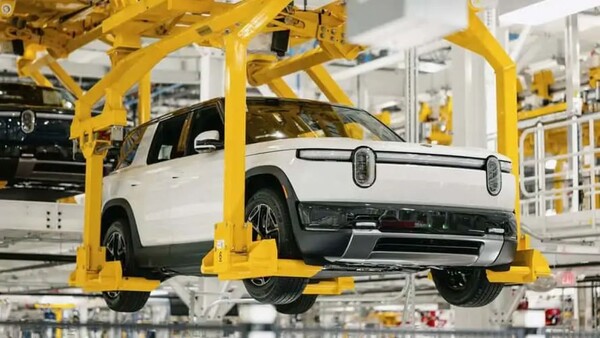
[Digital Today intern reporter Yoo Seung-a] Rivian has set a goal of automating up to 80 percent of work at its vehicle plants with robots. It plans to start by assigning about 20 percent of factory tasks to robots, then gradually expand the scope by improving software performance.
On Nov. 12 (local time), EV-focused outlet InsideEVs reported that Rivian CEO RJ Scaringe (RJ 스캐린지) said in an interview with venture capital firm Kleiner Perkins, "Initially, we will automate 20 percent of factory work, and over time I want to expand that to 80 percent." The plan is based on technology from Mind Robotics, which Rivian spun off in 2025.
Rivian's goal goes beyond simply deploying more conventional industrial robots. In auto plants, robot arms that pick up parts and install them in designated locations are widely used. Such equipment is manually programmed to repeat the same motions and can operate only when parts are placed in the same position each time.
Rivian also wants to replace repetitive work in which people take parts out of bins and place them on jigs with artificial intelligence robots. It aims to enable the robots to recognise and work even if the location of the parts varies slightly.
Scaringe said this is an area that can be automated first. "These tasks are generally the least interesting, but the actual volume of work is substantial," he said, adding that depending on the factory area, up to 50 percent of the workforce is assigned to pick-and-place work that involves picking up and moving parts.
To that end, Rivian is working with Mind Robotics on software and hardware development. The two companies have also hired talent from the consumer electronics industry. Scaringe said experience developing tactile sensing technology can also be used to develop robots' tactile sensors, and that capabilities accumulated in related fields are being applied to robot development.
Factory work videos are used for robot training. Engineers filmed thousands of tasks on production sites and fed the footage into software to analyse the characteristics of each task and its difficulty in terms of dexterity and reasoning. The software interprets the tasks in the videos and issues commands to the robots, and Scaringe said the model will improve over time if equipped with appropriate hardware.
The approach also aligns with Rivian's vehicle software strategy. The second-generation R1S and R1T have hardware installed to implement a hands-free driving function to a destination. The software that runs it is set to be provided on a limited basis via an over-the-air update in late 2026, with the scope of application to be expanded in 2027.
The time needed to raise the automation rate of factory robots to 80 percent has not yet been specified in detail.
 Yoo Seung-a
ysah@d-today.co.kr