
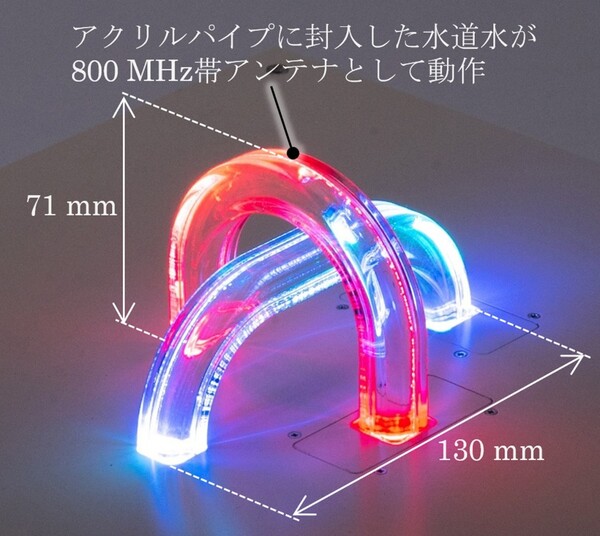
[Digital Today reporter Jinju Hong] Japan's Mitsubishi Electric has developed an antenna that transmits and receives radio waves using tap water and succeeded in a communications test with a mobile device. The transparent antenna uses water instead of metal and is positioned as a new communications infrastructure technology that maintains communications quality while considering harmony with surrounding scenery.
On Nov. 11 (local time), Japanese outlet ITmedia reported that Mitsubishi Electric developed an antenna using tap water called Liqutenna. The company said the successful communications between an antenna that transmits and receives radio waves using tap water and a mobile device is the first case in the telecommunications industry.
Liqutenna has a structure in which an acrylic pipe is filled with tap water. Unlike a typical metal antenna, it features a transparent appearance and focuses on providing communications functions without harming the aesthetics of the installation space. Mitsubishi Electric introduced it as a new antenna installation method that achieves both communications quality and consideration for scenery.
The key is actual communications performance. Mitsubishi Electric conducted a connection test between an 800 MHz-band Liqutenna prototype and a mobile device in KDDI's indoor wireless communications facility evaluation environment. It explained that the results confirmed no difference in connection performance compared with a typical metal antenna.
There were also technical hurdles to using tap water as an antenna material. Tap water has much lower conductivity than seawater, making it unfavorable for transmitting and receiving radio waves. Mitsubishi Electric addressed this based on technology accumulated during the development of SeaAerial, a seawater antenna it unveiled in 2016.
The company said it secured connection performance equivalent to that of a metal antenna despite the low conductivity of tap water by adjusting the inner diameter and shape of the acrylic pipe.
The technology is drawing attention because it could reduce installation constraints and landscape issues associated with existing metal antennas. It explained that when building communications infrastructure, not only antenna performance but also harmony with a building's exterior and the surrounding environment must be considered, and that a transparent structure could become a new alternative.
Additional verification is needed for actual commercialization. Mitsubishi Electric plans to work with KDDI to carry out demonstration evaluations in areas where radio waves do not reach well. Whether the performance confirmed in the indoor test is maintained in real environments is expected to be key to future commercialization.
It plans to disclose technical details at Microwave Exhibition 2026, to be held from Nov. 25 to 27 at Pacifico Yokohama in Yokohama, Japan.
 Jinju Hong
hongjj@d-today.co.kr