
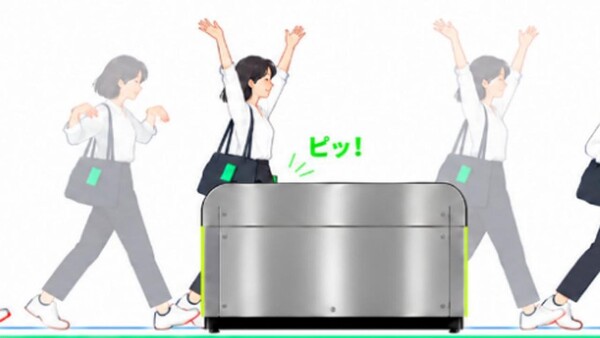
[Digital Today reporter Choi Jae-won (최재원)] Japan’s JR East will introduce walk-through ticket gates from spring 2028 that allow passengers to pass without taking out a smartphone or holding a transit card to a reader. It will first apply the system at 40 stations, including stations on Tokyo’s Yamanote Line and those linked to Narita and Haneda airports, and then expand installations.
On Nov. 11 (local time), Japanese media outlet ITmedia reported that JR East announced a plan to introduce a contactless ticket gate system using ultra-wideband (UWB) wireless technology.
UWB is a technology that uses radio waves to precisely identify a smartphone’s location and distance. If a user uses Mobile Suica on a smartphone that supports the technology, the user can pass through the ticket gates without taking the device out of a pocket or bag.
JR East explained that passengers can pass through at a speed similar to tapping Mobile Suica. It is also convenient when pulling luggage or using a stroller or wheelchair. Users can keep using existing commuter passes and stored value balances, and the new gates also support the existing tap method.
Passengers can also enter via walk-through at the departure station and exit by tapping a smartphone at the arrival station. Each station’s ticket gates will have 1 walk-through lane for entry and 1 for exit. The smartphone models to be supported in the full service will be announced later.
Ahead of the full rollout, JR East will run a trial from April 10, 2027 to Feb. 29, 2028 at 14 stations in the greater Tokyo area, including Tokyo, Shinjuku, Shibuya and Shinagawa. It will lend about 400 commuter pass holders in the relevant station sections Sharp’s AQUOS R10 to verify recognition accuracy and whether it operates under crowded conditions. During the trial period, the walk-through method can be used only for commuter pass sections between designated stations.
Sony, FeliCa Networks and JR East Mechatronics are participating in the technology development. They will be responsible for the gates’ communications devices, smartphone security software, and the manufacture and installation of the gates, respectively.
JR East plans to expand the service to all stations equipped with ticket gates by the end of fiscal 2031. In the mid-2030s, it also plans to introduce GPS-based smartphone ticketing to create an environment in which stations can be used without separate ticket gates.
 Choi Jae-won
ittt_0801@d-today.co.kr