
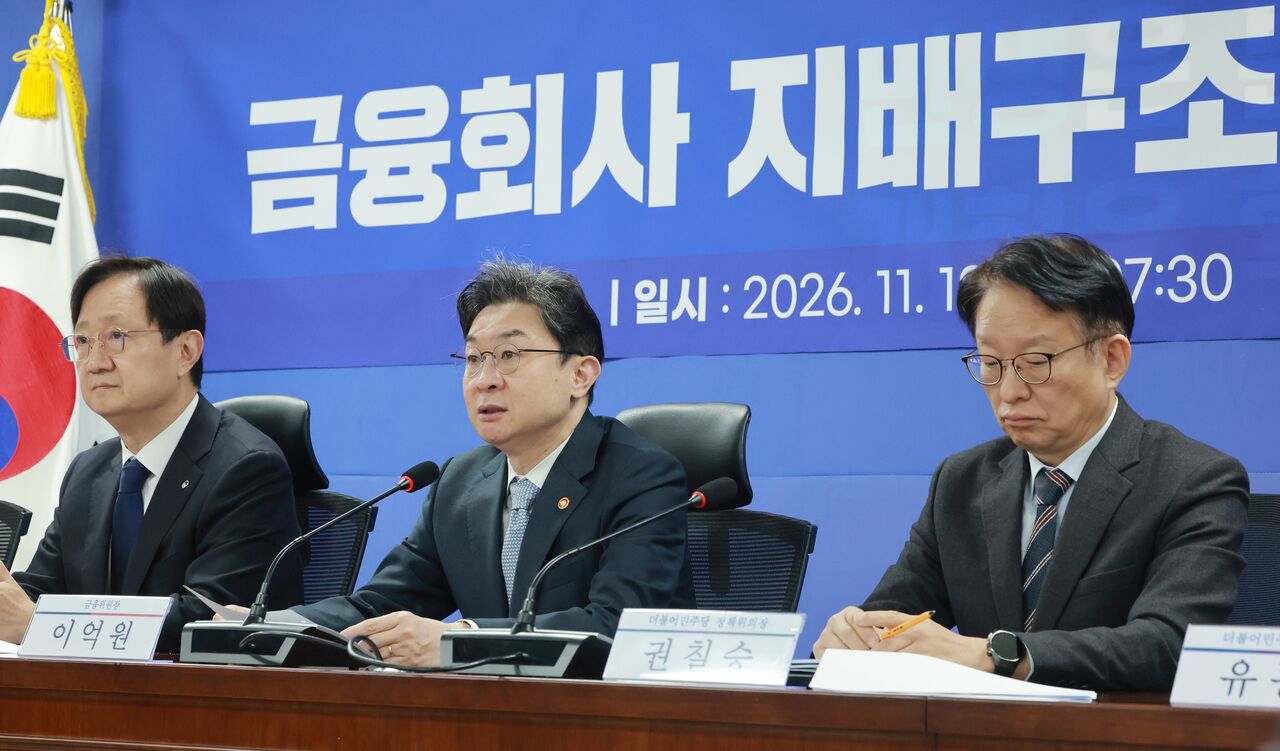
South Korea's financial authorities have drawn up measures to tighten voting requirements for the reappointment of financial holding company chairs and to boost board independence. The follow-up steps come after special inspections of 8 bank holding companies found cases where outside directors failed to effectively check management and succession procedures were run in ways that favoured incumbent chairs. Attention is focusing on whether governance structures led in effect by incumbent chairs and boards in appointing and reappointing holding company chairs will change.
The Financial Services Commission and the Financial Supervisory Service said on Nov. 12 that the government and the Democratic Party confirmed a set of measures to improve financial company governance at a party-government meeting. The package aims to address the practice of long-term CEO reappointments and strengthen the independence and accountability of boards.
The core of the measures is to tighten voting thresholds at executive nomination committees and shareholder meetings in the appointment and reappointment process for bank holding company chairs, strengthening checks on incumbent chairs.
The threshold for a nomination committee to recommend a chair will be raised to approval by at least two-thirds of all members for an initial appointment, and at least three-quarters for a reappointment. At shareholder meetings, the current requirement will remain for an initial appointment, but a first reappointment will require approval by at least two-thirds of voting rights represented at the meeting and at least one-third of total shares issued. For a second or further reappointment, the thresholds will be at least three-quarters of voting rights represented and at least one-half of total shares issued.
The nomination committee that recommends CEO candidates will be composed entirely of independent directors. New rules will also be introduced to prevent an incumbent chair from improperly intervening in the succession process. The plan calls for disclosure of the reason and details when there is contact between an incumbent chair and nomination committee members during the succession process, in order to reduce the possibility of the chair exerting influence.
Even if voting requirements are strengthened, the impact of the changes could be limited if boards that review and recommend candidates do not secure sufficient independence from management. That leaves the key question of whether outside directors who operate the new voting standards can carry out meaningful oversight.
Chair's close associates as outside directors... only 1 dissenting vote out of 6,100
The background to the governance measures lies in the dispersed ownership structure typical of bank holding companies. Bank holding companies without a controlling shareholder have faced criticism that individual shareholders find it relatively difficult to check management, while the influence of long-serving chairs could affect boards and succession procedures.
The FSS's special inspections of 8 bank holding companies this year showed such concerns also appeared in actual operations. In particular, the inspections found structural problems in which an incumbent chair could exert influence from the process of appointing outside directors, who should act as a check on the chair.
At some holding companies, a professor who supervised the incumbent chair's doctoral thesis served as head of the nomination committee and was involved in selecting the candidate pool. At another holding company, a senior executive of an organisation the incumbent chair supported while serving as a bank chief was appointed as an outside director and took part in screening the chair's reappointment. The inspections found cases where people with personal ties or academic connections to an incumbent chair were appointed without sufficient verification of their independence and later became involved in the chair's reappointment process.
The problem was that outside directors appointed in this way also failed to show sufficient independence in their role of checking management in practice.
Among 6,100 votes last year by boards and subcommittees at the 8 bank holding companies, there was only 1 instance in which an outside director voiced opposition. All outside directors received the highest or second-highest grade in evaluations, with no cases of replacement based on evaluation results, and most were found to serve until the legally allowed limit.
The fact that there were few dissenting votes alone does not allow a definitive conclusion that all board deliberations were merely formal. Still, the special inspections also found problems in which evaluations of outside directors were overly focused on attendance and did not sufficiently reflect substantive participation such as the number and content of remarks.
This means mechanisms to verify independence and accountability did not work properly from appointment through evaluation and reappointment of outside directors. In a structure where people connected to an incumbent chair enter the board and the board then decides the chair's reappointment, the ability to check management could weaken.
Financial support for outside directors was also cited as a factor that could undermine independence. Non-executive outside directors were paid about 93 million won a year on average, and additional benefits such as cars and drivers were provided. Some holding companies were found to have continued financial support by appointing retired outside directors as advisers.
Succession procedures that favour incumbents... rival candidates lack even opportunities for vetting
In management succession procedures, cases were found in which boards were run in a direction that maintained existing management systems rather than checking incumbent chairs.
Some holding companies changed age limits for eligibility after starting succession procedures for a chair's reappointment, extending the incumbent chair's possible tenure. Other holding companies carried out the shortlisting process in a single day or provided a candidate list on the day of the nomination committee meeting, pushing ahead without sufficient deliberation.
These problems also led to a competitive environment that was disadvantageous to external candidates.
One holding company required external candidates to submit applications that needed significant preparation within 5 business days, prompting most candidates to abandon their applications. In contrast, there was also a case in which an incumbent chair received support from internal support units, including help preparing presentation and interview materials for candidate screening.
In the candidate evaluation process, cases were found in which rival candidates were asked negative questions while the incumbent chair was given the highest score without separate questions, or board minutes were revised after the fact to favour the chair.
This shows that securing multiple candidates and running a competition process alone does not guarantee fair succession. If external candidates are not given sufficient preparation time and opportunities for vetting, expanding the candidate pool may still leave an incumbent chair in a relatively advantageous position.
In fact, the special inspections found that 6 of 7 external candidates at one holding company did not consent to reputational checks or declined to run, and at another holding company both external candidates included in the final shortlist did not attend interviews.
Financial authorities are also pushing measures such as managing candidate pools, specifying evaluation standards and guaranteeing preparation time for external candidates alongside tighter voting requirements for chair reappointments, in what is seen as an effort to address these structural issues.
Beyond tougher voting thresholds, candidate vetting is key to effectiveness
Based on the measures, financial authorities plan to draw up amendments within this year to the Financial Company Governance Act, related subordinate rules and best-practice guidelines. They also plan to first pursue items that financial companies can implement voluntarily even before legal revisions.
In particular, they will encourage earlier starts to CEO succession procedures to secure a minimum vetting period and strengthen disclosure of evaluation criteria and results. The plan is to provide external candidates with sufficient preparation time and overhaul ongoing candidate pool management systems to reduce imbalances between incumbent chairs and rival candidates.
The overhaul is also meaningful in that it does not stop at limiting the reappointment of bank holding company chairs, but seeks to expand the roles of boards and shareholders in the chair appointment process.
Still, raising voting thresholds alone does not immediately resolve chair-centred governance. As the special inspections showed, if the appointment and evaluation of outside directors are run formally, decisions favourable to existing management could be repeated even under tighter voting requirements.
How much measures to improve transparency in the appointment process for independent directors and strengthen accountability for candidate evaluation and recommendations are reflected in the operation of financial holding company boards is likely to determine the effectiveness of the changes.
Financial sector watches succession transparency ahead of next chair selections
Attention is also turning to succession procedures at financial holding companies preparing to pick their next chairs. NH Nonghyup Financial Group's chair, Lee Chan-woo (이찬우), is due to see his term expire on Feb. 2 next year, making the selection process a key issue. While Nonghyup Financial differs from typical dispersed-ownership bank holding companies because it has a unique ownership structure dominated by the National Agricultural Cooperative Federation, it aligns with the measures in terms of nomination committee independence and objective candidate vetting.
iM Financial Group is also conducting procedures to select its next chair ahead of the expiration of Chair Hwang Byung-woo's (황병우) term in March next year. After launching a succession process in September, it narrowed a longlist to 6 internal and external candidates in late October and plans to select a final candidate in December.
But the measures have not yet been legislated, so the tighter voting requirements do not apply to the current chair selection at the two financial holding companies. Even so, with financial authorities presenting blocking incumbent influence and fair competition among candidates as the core of governance reform, interest is expected to rise over the independence of candidate vetting and procedural transparency in these selections as well.
Ultimately, the effectiveness of the overhaul depends on whether the tighter voting requirements can translate into greater board independence and stronger oversight.
Kwon Chil-seung (권칠승), policy chief of the Democratic Party, explained that the measures are intended to establish a principle under which boards and shareholders meaningfully check management, with rewards for performance and responsibility for losses.
Financial Services Commission Chairman Lee Eok-won (이억원) stressed that corporate governance at financial companies is an issue directly linked to financial market stability and public trust, and said he would drive substantive change through revisions to laws, subordinate regulations and best-practice standards.
Financial Supervisory Service Governor Lee Chan-jin (이찬진) said that for institutional improvements to lead to real change, the expertise and responsible performance of independent directors must underpin them, adding that he would support on-the-ground adoption of the system through revisions to best-practice standards and checks on implementation status.
 Lee Ji-young
ljy@d-today.co.kr