
Naver plans to launch a personal AI agent this year that performs various tasks for users, including shopping, booking and payments. It aims to connect information obtained from search to actual purchases and transactions, and to expand logistics and offline payment businesses as it pursues a shift to an AI-based platform.
Naver on Nov. 12 disclosed plans on a conference call for its third-quarter results, including the launch of a personal AI agent, an advertising monetisation strategy, expanded logistics infrastructure and an AI Factory business plan.
On a consolidated basis, Naver's third-quarter revenue rose 10.7% from a year earlier to 3.47 trillion won, but operating profit fell 20.9% to 451.3 billion won. It attributed the decline to higher investment costs in infrastructure, content and offline businesses. The operating margin was 13.0%, and net profit was 402.5 billion won.
FACTBOX: Personal AI agent to launch this year, from search to executing transactions
Naver plans to strengthen AI functions in its existing search service while launching a separate personal AI agent app within this year.
Naver CEO Choi Soo-yeon (최수연) said, "The personal AI agent aims to offer a new usability that goes beyond users directly finding the information they need, by taking care of what they need in advance or performing cumbersome tasks on their behalf."
The new agent aims to link steps from product search to booking and payment, depending on a user's request. It is designed so that the user makes key decisions directly, such as payments and confirming reservations.
Naver is preparing to connect its in-house systems, including shopping, Place, reservations, maps and Naver Pay, so AI can quickly handle necessary tasks. It is also developing a way to process user requests for external services not directly connected to Naver in an isolated browser environment.
Choi emphasised that Naver's search, shopping and payment data and its service linkage structure are competitive strengths. It is also reviewing ways to expand partnerships with external companies and expand into global services.
Naver also disclosed results from its existing AI services. User flows in the AI tab that connect to shopping and local information services have risen to nearly double compared with the initial launch. From March to September, the number of users of its shopping AI agent rose about fivefold and transaction value increased about fourfold.
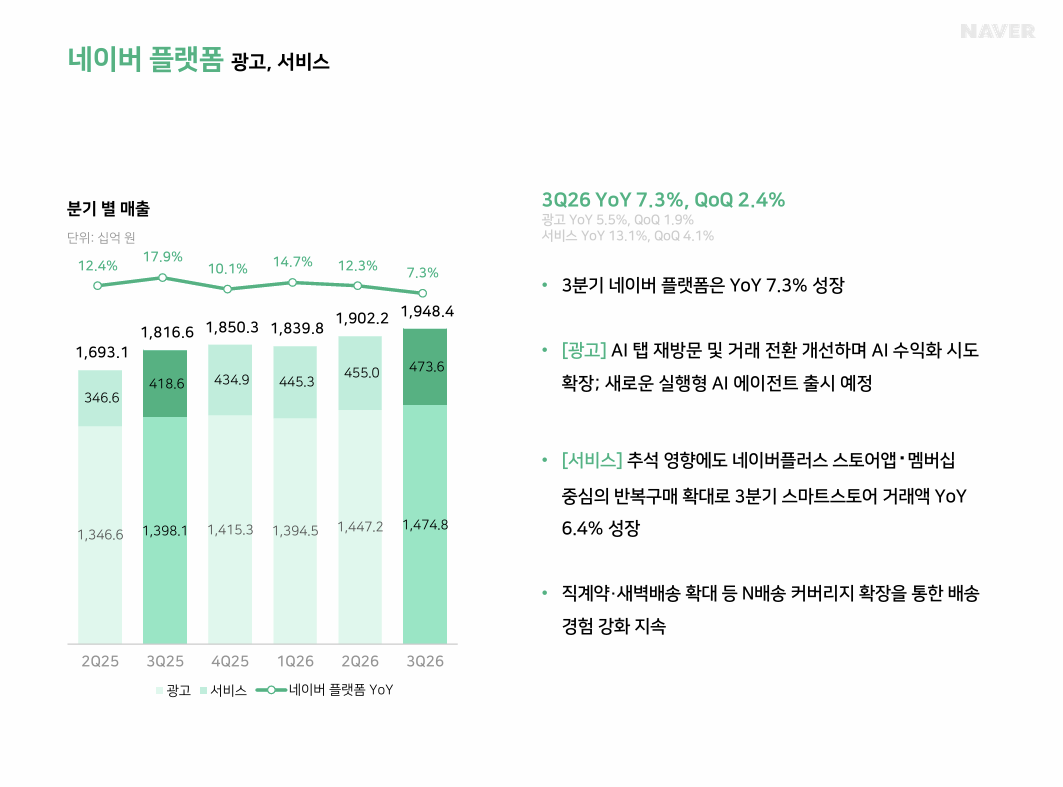
In its advertising business, Naver will expand a method of pricing ad spending based on actual purchases and transaction performance rather than clicks, using AI. With AI prediction models applied, click-through rates and conversions for Powerlink improved 12% and 9%, respectively. In the first half of next year, it will push a pilot programme to expand transaction performance-based advertising to finance, insurance and autos.
FACTBOX: Logistics subsidiary to be set up, about 1 trillion won investment through 2030
In commerce, Naver is moving to strengthen delivery competitiveness. It plans to establish a logistics-focused subsidiary and gradually expand delivery infrastructure centred on leased logistics centres.
Choi said it would likely require investment of nearly 1 trillion won through 2030. Naver will continue cooperation with existing partners for logistics centre operations and delivery, while leading the design of logistics systems and data infrastructure.
Naver's third-quarter Smartstore transaction value rose 6.4% from a year earlier. The share of the Naver Plus Store app in Smartstore transaction value exceeded 20%, and transaction value from AI recommendations rose more than 50% from a year earlier.
Transaction value for N Delivery rose 38% from a year earlier. Naver plans to use search data to forecast product demand and boost delivery speed by placing inventory at logistics hubs close to users.
It is also expanding its offline payment business. Naver Pay's third-quarter payment volume rose 15.6% from a year earlier to 26.2 trillion won.
Choi said Naver will link not only in-store payments but also reservations, customer management and marketing services through wider distribution of Naver Pay Connect terminals. She also presented a goal of becoming the No. 1 operator in South Korea's integrated offline terminal market by active terminals in the first half of next year.
FACTBOX: AI Factory 2 trillion won deal is five-year revenue, expected to contribute to profit next year
Naver also detailed profitability prospects for its AI Factory business, a new growth engine.
Naver has signed a computing services supply contract worth about 2 trillion won with a U.S. AI inference company, and plans to begin commercial service in the first half of next year.
In the conference call Q&A, it confirmed the deal corresponds to supply volume of about 20 megawatts (MW), and that the 2 trillion won contract value is not annual revenue but total revenue over about five years of supply.
Naver expects the AI Factory business to generate operating profit from 2027 even after excluding related costs and other expenses. It said margins will be low in the first year due to a lag between equipment adoption and service launch, but from 2028, when operations ramp up in earnest, it expects an operating margin well above the double digits.
It said there is currently one confirmed supply contract and it has not yet disclosed the specific scale of profit contribution.
It is also working to secure additional customers. Naver said it is discussing supply contracts with more than 10 companies and is preparing to expand services using Nvidia's next-generation GPU, "Vera Rubin."
Naver expects the decline in profitability in its platform business due to computing infrastructure investment, sports broadcasting rights costs and expanded commerce marketing to ease from the fourth quarter. It said it would be difficult to recover the roughly 30% profit margin it had in the past in the short term, and presented a goal of stably maintaining a margin of around 25% going forward.
 Lee Ho-jung
lhj@d-today.co.kr