
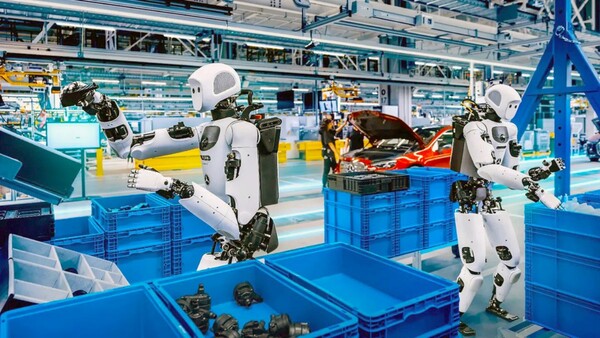
[Digital Today reporter Jinju Hong (홍진주)] An AI humanoid robot has been deployed on an actual car production line. DeepMind’s humanoid Apollo 2 was confirmed to have carried out kitting work at a Mercedes factory, sorting parts and delivering them to the assembly process. The development is drawing attention because a humanoid has moved beyond labs and demonstration sites into a real manufacturing workplace.
CryptoSlate reported on Nov. 11 local time that Apollo 2 took on parts-kitting work on Mercedes’ operating car production line. Kitting involves sorting and bundling in advance the parts needed for car assembly and delivering them to the next process. It is one of the key processes for keeping production flow smooth.
The significance of the case lies in the fact that a humanoid was deployed in actual factory operations rather than a controlled demonstration environment. Car manufacturing sites are complex and must move reliably in line with production schedules, making them a venue for testing whether robots can be applied in the field.
However, disclosed information is limited for judging whether it is at a commercialisation level. It is not known how many production lines Apollo 2 worked on or how long the trial operation lasted. The share of human intervention was also not disclosed.
In particular, the degree of worker intervention is a key indicator for evaluating a humanoid’s autonomy and productivity. Even if a robot performs repetitive tasks, automation effects could be limited if people have to intervene whenever part locations change or unexpected situations arise.
The scope of the test and operational results have also not been confirmed. That is because indicators for assessing the economics of factory deployment, such as productivity gains, error rates, safety, continuous operating time and operating costs, have not been released. It is also unclear whether the deployment was a pilot limited to some processes or at a stage that could expand to a wider production environment.
Even so, the fact that it performed work on an actual Mercedes production line shows that humanoids’ entry into manufacturing is becoming a reality. Because car factories are environments where various parts and complex work routes intersect as well as repetitive tasks, operating experience there could be an important testbed for gauging the effectiveness of humanoid technology.
In the end, the case is meaningful in that a humanoid has set foot in a real manufacturing process, but whether full-scale commercialisation is possible will require additional data. It will be key whether the size of future tests, the share of human intervention and productivity improvements are disclosed.
 Jinju Hong
hongjj@d-today.co.kr