
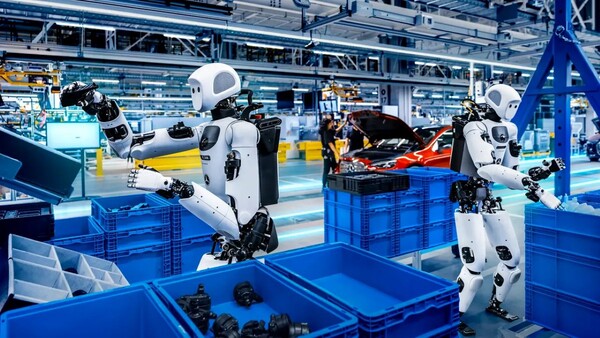
Google DeepMind, the AI research group at Google's parent Alphabet, unveiled Gemini Robotics 2.5, a next-generation AI model that boosts robots' real-world work capabilities. It improves robots' manipulation skills, reliability and safety so they can work with people and carry out a range of tasks in industrial settings.
On Nov. 11, Google and SiliconANGLE introduced Gemini Robotics 2.5 as the company's best-performing vision-language-action (VLA) model to date. DeepMind said it accelerated robotics research using Gemini 4 Argon and improved the system so robots learn new skills faster and more broadly. The model was evaluated on performance across more than 200 individual tasks.
The main areas of improvement are advanced manipulation, reliability and safety. Robots can more accurately use everyday tools and handle delicate or flexible objects. In DeepMind's internal assessment, success rates were 30 to 100 percent higher than the previous model depending on task type, and task completion times were shortened by 20 to 30 percent.
DeepMind also verified performance in an industrial setting. It conducted a proof of concept (PoC) by deploying Apptronik's humanoid robot Apollo 2 on a Mercedes production line to sort and pack auto parts. It recorded a 96 percent success rate on the task. DeepMind said it was a proof of concept carried out in a real production environment and is separate from commercialisation results.
It also strengthened safety. DeepMind improved functions that control robot behaviour by considering physical hazards and people nearby, and introduced a new benchmark to evaluate malicious commands and jailbreak attempts targeting robots.
Gemini Robotics 2.5 runs on various robot platforms. It can be used not only on Apollo 2 but also on the Franka Duo platform equipped with parallel grippers on both hands. DeepMind has started providing the model through robotics partners including Agile Robots, Apptronik and Boston Dynamics.
Jeff Cardenas (제프 카르데나), Apptronik's co-founder and chief executive officer, said, "After combining Apollo 2 and Gemini Robotics, model performance improved significantly with only a few weeks of additional training, and there was little performance degradation even in the Mercedes production environment."
DeepMind also unveiled AlphaGenome 2, a next-generation gene prediction model. It predicts how DNA sequences and variants affect specific human cell types and can be used to identify disease-related genetic variants and find research candidates for new drug development. It distinguishes cell types and states in finer detail than the previous model and predicts DNA methylation as well as gene expression, histone modifications and chromatin accessibility. It is not approved for clinical or diagnostic purposes, as it is a model intended to support research.
 Seung-a Yoo
ysah@d-today.co.kr