
A South Korean research team has developed augmented reality (AR) glasses technology that allows text to be seen even in bright outdoor conditions. It reduced light loss inside the lens to produce bright images even with a thin profile.
The Ministry of Science and ICT said on Nov. 12 that a research team led by professor Noh Jun-seok (노준석) at Pohang University of Science and Technology jointly developed, with Samsung Electronics' Samsung Research, an optical technology that reduces light loss inside a metasurface waveguide. The research is due to be published in the international journal Nature.
To use AR glasses in everyday life, images must be visible in bright environments while the device remains thin and light like ordinary glasses. Existing technology has made it difficult to secure thickness, brightness and ease of use at the same time.
Conventional AR glasses send light from a small display into a thin waveguide and then use surface microstructures to change the direction of light and deliver it to the eye. Some light escapes in other directions during the process, dimming the screen.
Light loss increased, in particular, as the viewing range visible even when the eyes move was expanded. Another challenge was colour distortion, in which differences in transmission efficiency among red, green and blue light made certain colours appear overly bright or dark.
The research team improved the problem by precisely designing the entire path of light travelling inside the waveguide at the nanoscale. It reduced unwanted leakage and kept images bright even when the eye position changed.
To produce colour images, it applied a method that overlaps a layer that mainly transmits blue and green light with a layer that mainly transmits red and green light. By combining the two layers, the team built a metasurface-based waveguide with a total thickness of 1.5 mm.
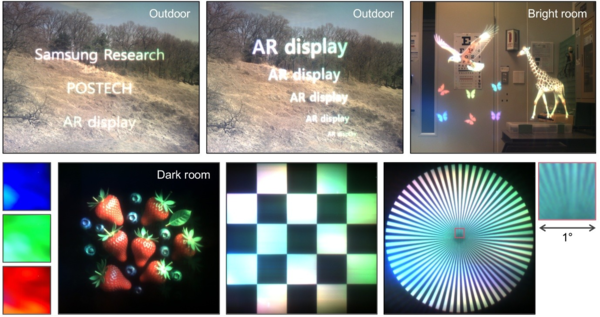
Using an AR glasses prototype applying the technology, the team succeeded in overlaying white text on real scenery in bright outdoor conditions and colour images indoors. It also enabled images to be viewed even when the eye position changed within a certain range.
This technology. It is expected to be used in everyday AR glasses that show route guidance and work information in front of the user's eyes. It may also reduce power consumption while maintaining screen brightness by increasing the efficiency of light use.
It also explained that additional research is needed for commercialisation. It must raise average luminance to meet brightness standards demanded by industry and secure technology to reduce two waveguides to one. It also needs to improve rainbow-like blurring caused by external light and differences in colour and brightness depending on viewing position.
Noh said, "We will improve rainbow blurring caused by light and secure mass-production technology, while linking it with AI-based customised image processing to develop AR glasses that can be worn comfortably in everyday life."
Kim Seong-su (김성수), director general for R&D policy at the Ministry of Science and ICT, said, "This achievement is a case in which basic research has led to core technology that resolves the limitations of next-generation displays." He added, "We will continue to support research that explores new principles and the development of core technologies based on it."
 Jin-ho Lee
jhlee26@d-today.co.kr