
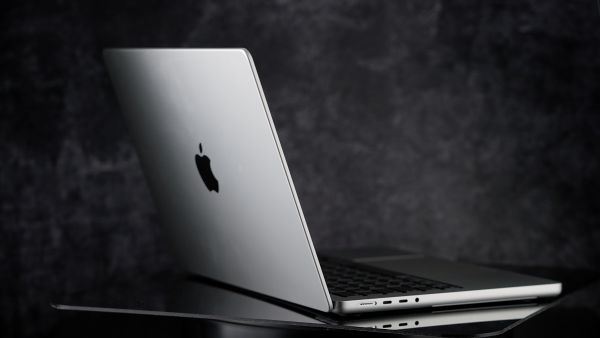
MacBook is seen as a product line that has changed the standard for the laptop market over the past 20 years. On Oct. 27, IT outlet Engadget reported that Apple has driven competition in design, portability, battery efficiency and high-resolution displays through the MacBook Pro and MacBook Air and its transition to Apple silicon.
Apple’s notebook strategy predates the MacBook. The Macintosh Portable in 1989 failed due to its 16-pound (about 7 kg) weight and high price, but Apple later laid the groundwork for portable Macs with the PowerBook 100, PowerBook 500 and PowerBook G3. The iBook G3 introduced in 1999 made its direction as a mass-market product clear, and the first MacBook Pro in 2006 expanded that trend in earnest.
In particular, the switch to Intel central processing units announced in 2005 is considered a turning point for the MacBook. Apple moved away from the PowerPC it had used and shifted to Intel Core Duo-based systems. It released the MacBook Pro, MacBook and a new iMac in 2006. The change meant the Mac was no longer confined to a separate ecosystem and entered a structure in which it competed head-on with Windows 11 PCs using the same chips.
Apple later changed market direction in industrial design as well. The unibody design applied to the 2008 MacBook Pro and MacBook Air used a method of carving a single block of aluminium. Engadget noted: "At the time, that design was stronger, lighter and more attractive than mainstream laptops."
PC makers did not immediately catch up. Apple had a tight grip on the metal chassis supply chain. Later, products such as the Razer Blade, Dell XPS 13 and HP Envy 14 responded by using aluminium, carbon fibre and Gorilla Glass, respectively.
The MacBook Air changed the form of ultra-light laptops. Redesigned 11-inch and 13-inch models unveiled in late 2010 adopted a wedge-shaped structure that was thinner at the front and thicker at the back, rather than simply being thin. The design secured space for a larger battery and a faster SSD. ASUS and Acer reflected that direction in their ultra-light laptops throughout the 2010s.
MacBook also sparked competition in displays. Apple applied the Retina display concept introduced with the iPhone 4 to the 2012 MacBook Pro. It promoted a level of sharpness where individual pixels were not visible, and high-resolution laptop competition accelerated. That helped push PC makers toward using better panels and more pixels.
Apple’s choices were not always universally praised. The 2016 MacBook Pro introduced the Touch Bar and removed many existing ports, leaving only 4 USB-C ports and a headphone jack. The design made the product thinner and lighter, but it also triggered backlash by removing an SD card reader, USB Type-A, HDMI and the dedicated MagSafe power port, which many professional users relied on. Engadget described the period as the peak of Jony Ive-style minimalism putting itself ahead of practicality. The Touch Bar also divided opinion from the start, and other PC makers did not actively follow it.
Even so, the changes left an impact on the industry. Premium laptops such as the Dell XPS 13, HP Spectre and Microsoft Surface also joined a trend of reducing ports after 2016. By contrast, ASUS and Acer and others sometimes chose to add back legacy ports to respond to consumer criticism and differentiate themselves from Apple.
The biggest shift was the introduction of Apple silicon in 2020. Apple redesigned the Mac around its in-house M1 chip. The chip combined the CPU, graphics processing unit, memory, AI NPU and input-output connectivity into a single structure. Engadget said the M1 MacBook Air and MacBook Pro were very fast and delivered a large increase in battery life, and that even apps running through emulation were difficult to distinguish in everyday use. Until then, Arm-based PCs in the Windows 11 camp were slow and lacked support for existing apps, but Apple showed a different approach alongside an operating system overhaul.
Apple redesigned the MacBook Pro around the M1 Pro and M1 Max in 2021 and restored an SD card reader and HDMI. It released the M2 MacBook Air in 2022. Microsoft then teamed up with Qualcomm to push Copilot+ laptops, and competition expanded in Arm-based notebooks aimed at battery life and performance similar to Apple’s. The Copilot+ brand itself did not achieve major success, but it clearly spurred improvements in Windows 11 laptop hardware.
More recently, Nvidia’s RTX Spark system-on-chip is being discussed as an attempt to challenge higher-end Apple silicon models in the high-performance AI laptop market. Products such as the Surface Laptop Ultra and the ASUS ProArt P16 adopted the chip, targeting demand for AI research with a powerful GPU and up to 128GB of unified memory. As competition in the laptop market shifts from thin designs to AI computing and power efficiency, the standards set by the MacBook remain a benchmark across the industry.
 Jinju Hong
hongjj@d-today.co.kr