
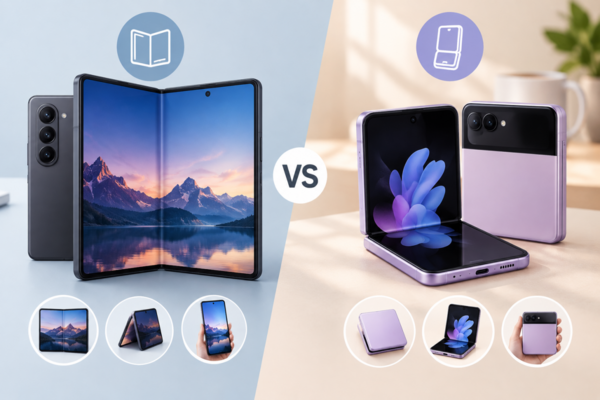
[DigitalToday reporter Jinju Hong (홍진주)] Foldable phones are broadly divided into clamshell (Clamshell·shell) designs and book types, and the criteria for choosing between the two form factors differ depending on which use comes first.
On this, IT media outlet Engadget on Oct. 27 (local time) pointed out that it is not about which is superior, but that the pros and cons split clearly depending on a user's daily patterns.
The clamshell's key feature is a structure that resembles past flip phones. When folded, it becomes small and close to a square, and when opened from bottom to top it can be used like a typical bar-style smartphone. Recent models have strengthened outer displays, making it possible to check information such as messages, incoming calls, the time and date, weather and schedules without unfolding. Engadget said clamshell models are advantageous for reducing unnecessary screen use by emphasising an outer screen that lets users check information at a glance.
The strengths of this approach are portability and one-handed operation. The body is small, making it easy to put in a pocket or small bag, and it offers an experience similar to a regular smartphone even after unfolding. Still, the screen size itself does not greatly exceed that of a standard smartphone, limiting multitasking on a large display or consumption of immersive content.
Book-type foldables, by contrast, are similar to standard smartphones when closed but tend to be thicker. When unfolded from right to left, a large screen closer to a tablet appears. This structure suits tasks where screen size makes a big difference, such as video, e-books, games and web browsing. Book-type models can also handle basic functions such as messages, notifications and launching apps via the outer screen even when closed.
Book types stand out in terms of productivity. Engadget said they allow use of a widescreen or split screen for work on the move, and some tasks also support drag-and-drop. That means the larger screen is advantageous for checking documents or using multiple apps. The structure is more complex, making devices bigger and heavier, and it also requires more attention to device management. It also mentioned that hinge protection is important.
Both types also share foldable-specific advantages. Examples include two-sided real-time translation using dual screens, photo previews using the outer camera, and taking photos and making video calls by standing the phone up or placing it in a tent form. It said the foldable structure itself goes beyond a simple folding design and leads to expanded ways of using the device.
In market trends, book-type foldables are gaining presence. A related survey raised the possibility that book-type foldable shipments could surpass clamshell models in 2026. As background, it cited an increase in what can be done on larger screens and, amid memory shortages, a trend of consumers moving to premium products with more memory. It said demand to handle both phone and tablet roles on a single device is bolstering book-type models.
Still, book types may consume more battery because they must drive two large screens. They remain about the size of a standard smartphone when closed, but the burden of thickness persists. Clamshell models, on the other hand, are much smaller and simpler, but face constraints in screen space and performance. In the end, choosing a foldable phone is closer to a matter of priorities than design preference. It suggested clamshell models for those who value frequently checked information and portability, and book types for those who prioritise watching video on the move, gaming and multitasking.
 Jinju Hong
hongjj@d-today.co.kr