
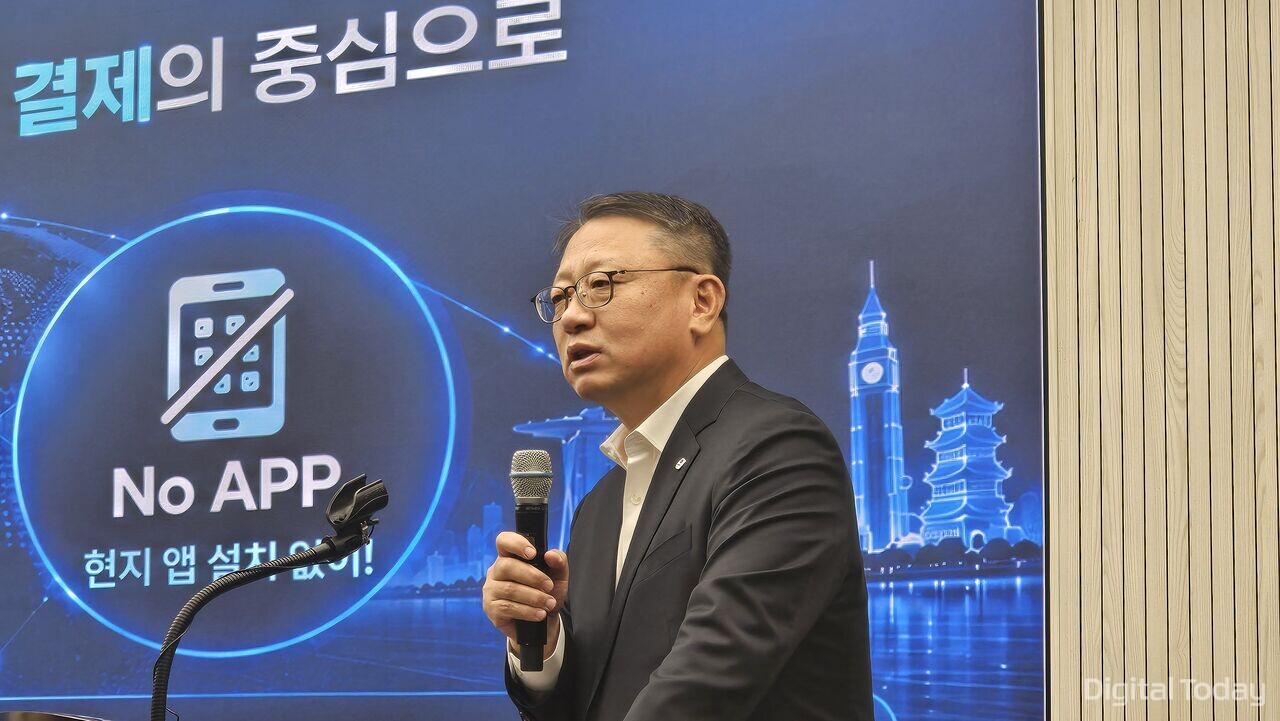
Woori Bank and Samsung Electronics have declared “No Card, No Cash, No App.” They plan to target the global easy-payments market with a service that allows payments using only a smartphone, without a physical card, cash or a separate local payment application. It supports both China’s WeChat Pay and Mastercard’s global payment network, expanding the scope of overseas payments.
Woori Bank held a “Samsung Wallet Money press briefing” on Oct. 28 at its headquarters in central Seoul. Woori Bank CEO Jin-wan Jeong (정진완) said there were “exactly three messages,” stressing “No Card, No Cash, No App.”
◆ 3 million users in a year, targets global payments beyond China
Samsung Wallet Money is a reloadable easy-payment service jointly launched by Woori Bank and Samsung Electronics in October last year. It secured 1 million subscribers within 2 months of launch and surpassed 3 million active subscribers as of Oct. 27. Woori Bank accounts had the largest share at 42 percent among 20 banks linked to top-up accounts, it said.
Woori Bank is expanding the service into overseas payments on the back of that user base. Starting Oct. 26, it began supporting payments via Samsung Wallet Money at WeChat Pay merchants in China and at Mastercard merchants globally.
In China, it partnered with Tencent’s WeChat Pay to respond to the local QR-payment environment. Globally, it enabled NFC payments through Mastercard’s payment network. Woori Bank said it would continue working with Samsung Electronics to expand overseas payment regions and partners.
◆ Payments without cards, currency exchange or extra apps, including table orders in China
The biggest feature of Samsung Wallet Money overseas payments is that users do not need to issue a separate physical card, exchange currency in advance or install a local payment app. Users can use it overseas after linking an account to Samsung Wallet Money in Korea and consenting to overseas payments.
Payment methods vary by region. In China, it supports QR payments linked to WeChat Pay, while in other overseas regions it provides NFC payments using Mastercard’s payment network. It enables both QR and NFC payments within a single Samsung Wallet app.
In China, it also supports a “table order” function that lets users order from a menu and pay by scanning a QR code installed at a restaurant table, in addition to scanning a merchant’s QR code or presenting their own. It also provides automatic translation of Chinese menus into Korean.
A Woori Bank official said during a question-and-answer session that the key strength is that one app supports QR payments and, when NFC is enabled while moving across regions, NFC as well. The official added that in China, the biggest feature is QR payments plus table orders.
Payment amounts are deducted from the topped-up prepaid balance, and if the balance is insufficient it is automatically topped up from the linked account. Woori Bank said it does not charge an annual fee or an overseas usage fee for overseas payments. The base points accrual rate is 0.3 percent, and users can earn up to 5.3 percent in points through year-end if they link a Woori Bank account and apply promotional benefits.
Jeong also described his own experience using Samsung Wallet Money in China and Hong Kong. He bought goods using a QR code in China and used Mastercard’s payment network in Hong Kong. He also explained, through a demonstration case, that upon arrival overseas the payment function suited to the region appears, and the overseas payment screen disappears upon returning to Korea.
◆ Personal data protection despite linkage to overseas networks, dual security system built
Questions also followed about the possibility of personal data leaks as the overseas payment service links to external networks such as WeChat Pay. Woori Bank said it converts and transmits a separate identifier instead of personal information that can directly identify customers, and applies encryption to that information as well.
Hyo-young Park (박효영), a manager in the Partnership Service Development Department, said, “There is no information that is classified as customer information at all.” Park said the service converts it into an identifier that can specify a customer for transmission and receipt, adding that it is safely handled because it is encrypted.
It also applied encryption technology to the process of exchanging data with external payment operators. Woori Bank said data is transmitted and received between partners through APIs, and the system is designed to provide the relevant encryption keys only to partners agreed in advance.
It also stressed that it uses Samsung Electronics’ hardware-based security technology together with Woori Bank’s financial security system. It applies masking of sensitive information, one-time payment tokens and a separate security key management system, and it added Samsung Wallet Money-specific detection rules to the bank’s fraud detection system (FDS) to monitor transactions with a second layer.
It also disclosed a case of preventing actual damage. It said a fraudulent user impersonating a child opened a so-called burner phone using a parent’s personal information and tried to sign up for Samsung Wallet Money to steal funds, but the FDS detected suspicious signs and blocked about 2 million won in losses in advance.
It also said it requires a separate verification procedure when abnormal transactions occur overseas in a short period. For example, if a payment occurs in Macau within 30 minutes of a payment in Korea, it can judge it as an abnormal transaction and proceed with additional identity verification.
On the possibility of fraudulent payments due to a lost mobile phone, it said biometric authentication or entry of a payment password is required. In the event of loss, it said the service can be stopped immediately through an ARS at its 24-hour customer centre.
Woori Bank said it also applies banking-sector financial incident response procedures to Samsung Wallet Money, from payment suspension to damage relief and refunds.
◆ Expansion of cardless payments, cooperation with Woori Card to be reviewed later
As payment services without physical cards expand, attention is also focused on their relationship with existing card businesses.
Samsung Wallet Money is a service built through cooperation between Samsung Electronics and Woori Bank, with Samsung Card participating in the mobile card issuance structure. Woori Card, an affiliate, is not directly involved at present, but Woori Bank said it would review the possibility of cooperation with affiliates such as Woori Card if the foundation for the prepaid payment business expands.
Park said Samsung Wallet Money was built on collaboration with Samsung Electronics, with Samsung Card participating in the mobile card issuance structure. Park said there is no area for Woori Card to participate directly under the current business structure, but if Samsung Wallet Money serves as a foundation to expand the influence of the prepaid payment business, Woori Bank could later secure a prepaid influence and, based on that, could review cooperation with affiliates.
Woori Bank is also expanding a direct-merchant structure in the domestic payments market to reduce intermediary steps by card companies. It directly connected with major merchants such as CU and GS25 to cut intermediary fees and used the savings for customer point accrual or lower merchant fees.
Jeong said breaking away from “cards” is a global trend that is beginning, and stressed that payment methods centred on physical cards are changing.
He added that it considered both customer convenience and safety, saying it paid more attention to building security systems behind the scenes while providing easy payment services.
Woori Bank, meanwhile, expects an effect of attracting new customers by providing services that improve customer convenience, rather than securing profitability immediately.
 Ji-young Lee
ljy@d-today.co.kr